


On 26 November 2026, Michalis A. Michael, Founder & CEO of listening247 and lead author of AI Powered Insight (Routledge, 2026), presented From Noise to Insight, a one-hour professional webinar for the Market Research Society. 285 people registered and 118 joined live, from research agencies and client-side insight teams.
The most common theme was building in-house: how hard it is to train your own small language model, whether every step can run in one internal AI tool, and where to host the models. Others asked how to catch a trend you never set up a topic for, how to tell real shifts from noise with younger audiences, whether people tell the truth online, and where to start without huge token costs.
“Wow! Thank you. A real eye-opener.”
“Blast, I bought the book after the first half and missed the discount! Thank you. This was ace.”
Everyone who registered receives the recording, the slides and Michalis's written answers to every question. Over the coming weeks we'll turn the most common questions into articles here.
To go deeper, read AI Powered Insight, or get in touch to talk about how this could work for your team.

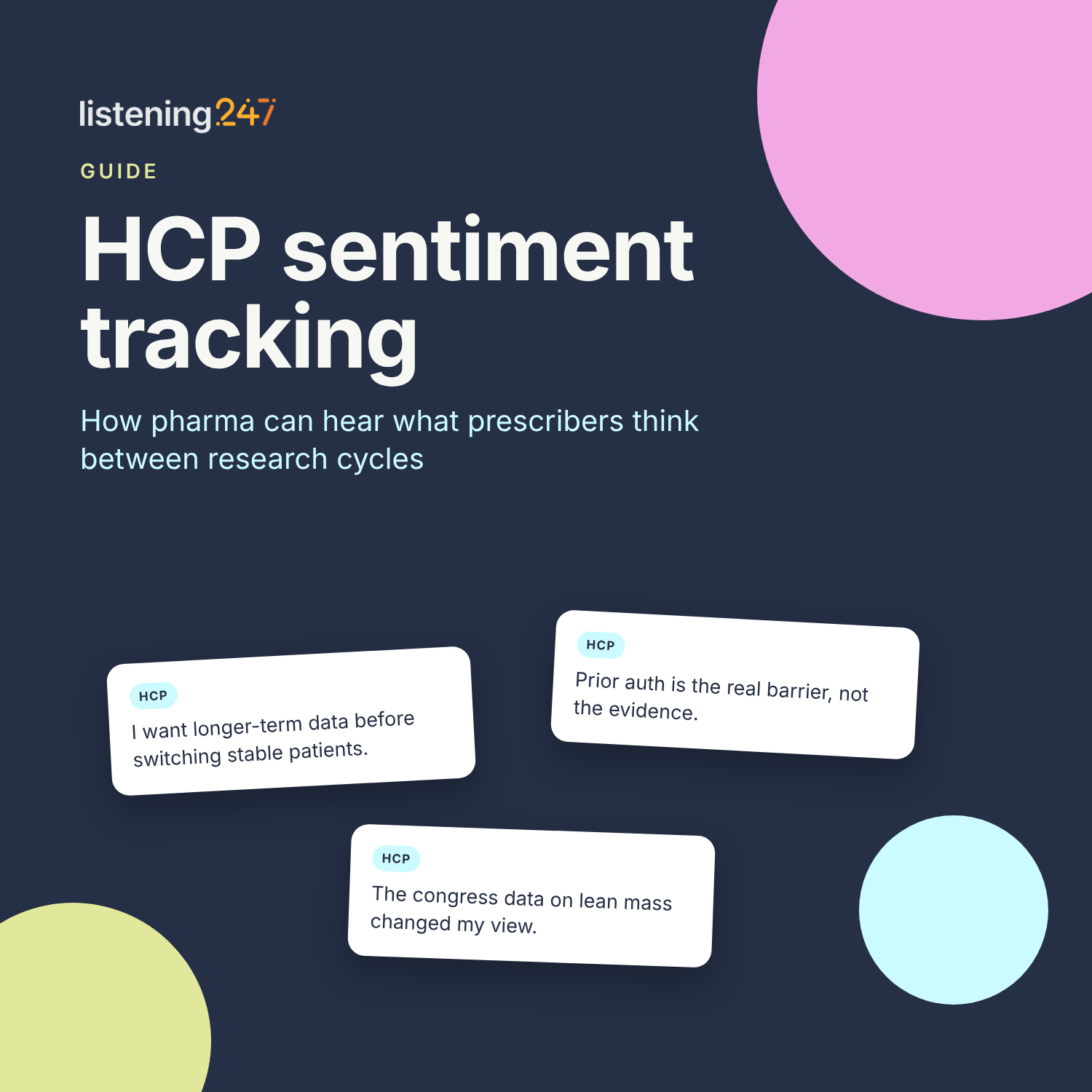
What healthcare professionals (HCPs) think of a treatment shapes whether it gets prescribed. Pharma teams usually learn this through field force feedback, market research, advisory boards and conversations with key opinion leaders. All of these are valuable, and all of them are periodic.
HCPs also talk about treatments online, every day. Tracking that conversation gives brand, medical and insights teams a continuous view of prescriber sentiment between research cycles.
HCP conversations happen in more places than most teams expect:
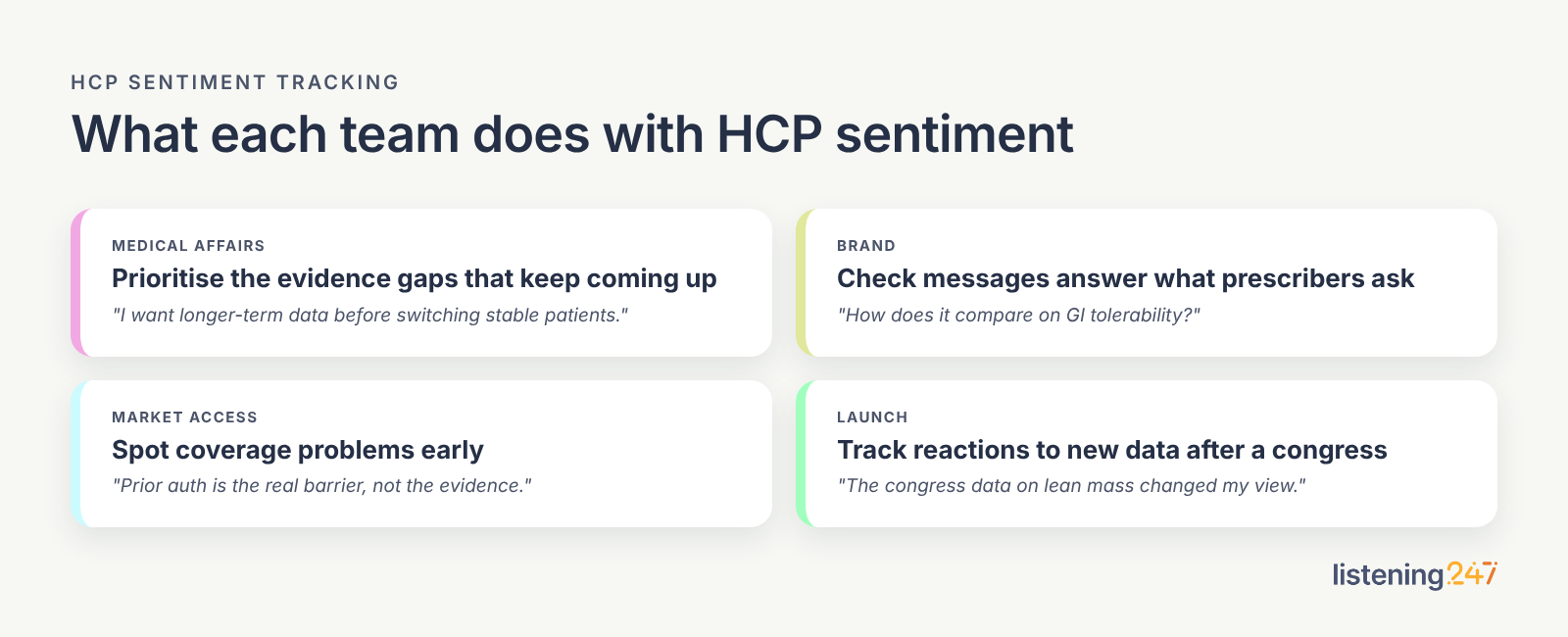
HCPs talk differently from patients. Their posts are more clinical and often more critical, which makes them especially useful for:
Patients usually post far more than HCPs. If you measure sentiment across all conversation, patient voices dominate and HCP views disappear. A brand can lead patient conversation and still trail with the prescribers who decide.
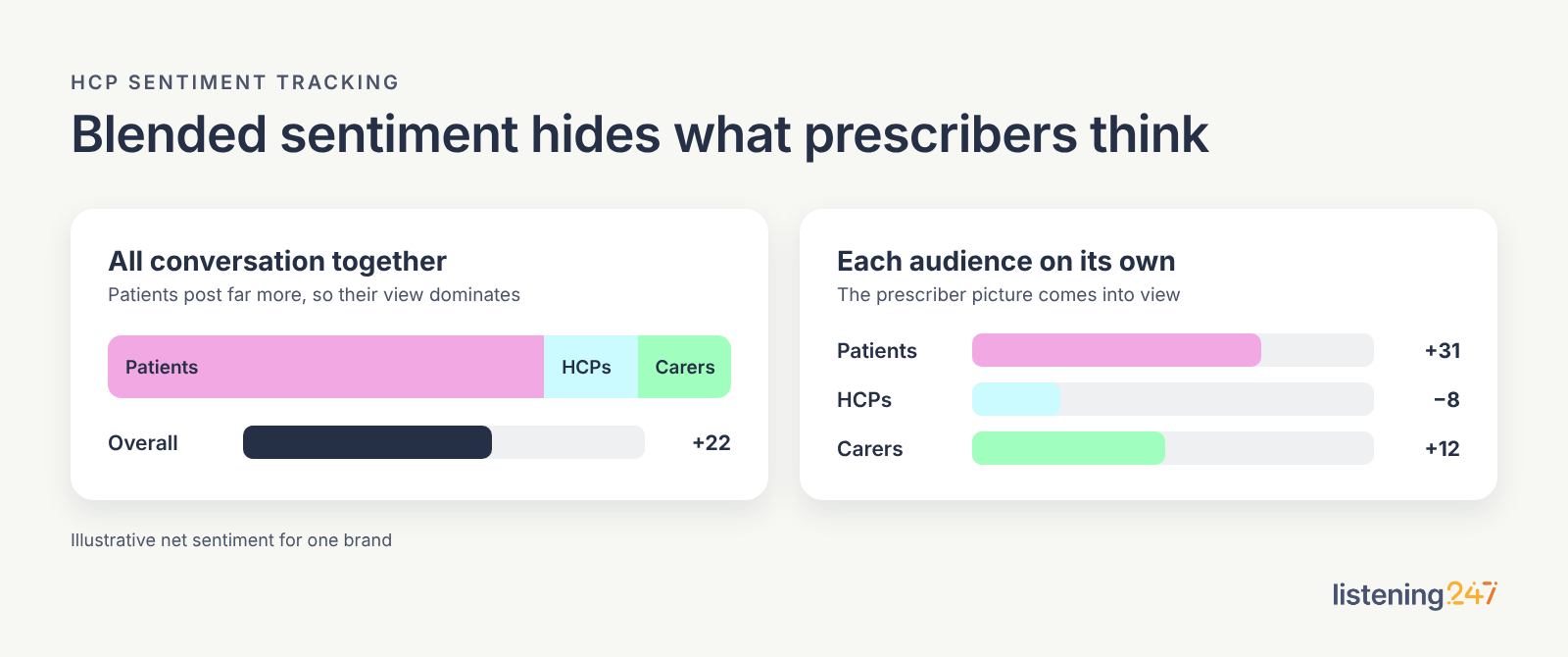
HCP language also needs its own models. A word that signals frustration from a patient can be a neutral clinical observation from a doctor. Sentiment has to be scored within each audience, not across all of them.
Classifying a post as coming from an HCP relies on several signals: professional credentials in a profile, clinical language, and the context of the conversation. AI models do the first pass, and analysts check samples to keep the classification accurate. No method is perfect, which is why accuracy targets should be agreed and measured.
Online HCP sentiment can't tell you how prescribers will react to a product that isn't on the market yet, because nobody is discussing it. For pre-launch questions, advisory boards and research are still the tools.
Posts from HCPs can also describe adverse events. Those need to be confirmed and escalated to your pharmacovigilance team through an agreed process, as explained in our guide to adverse events in social media listening.
listening247 analyses patients, HCPs and carers separately, with custom models trained only for your therapeutic areas. Accuracy is written into the contract: at least 80% F1 on sentiment and topics, 90% on brand relevance and over 90% for adverse events. Insight reports and recommendations arrive at the cadence you prefer, and every possible adverse event is confirmed by an analyst and escalated to your pharmacovigilance team on your timelines.
Read our full guide to social listening for pharma, or see how HCPs talk about your brand with a free brand snapshot, presented in a 15-minute meeting.
Some professional communities can be included when you give us access. Others remain closed, and a good provider is clear about what it can and can't see.
HCPs focus on evidence, efficacy, safety and access, and use clinical language. Their sentiment has to be measured separately so it isn't drowned out by the larger volume of patient posts.
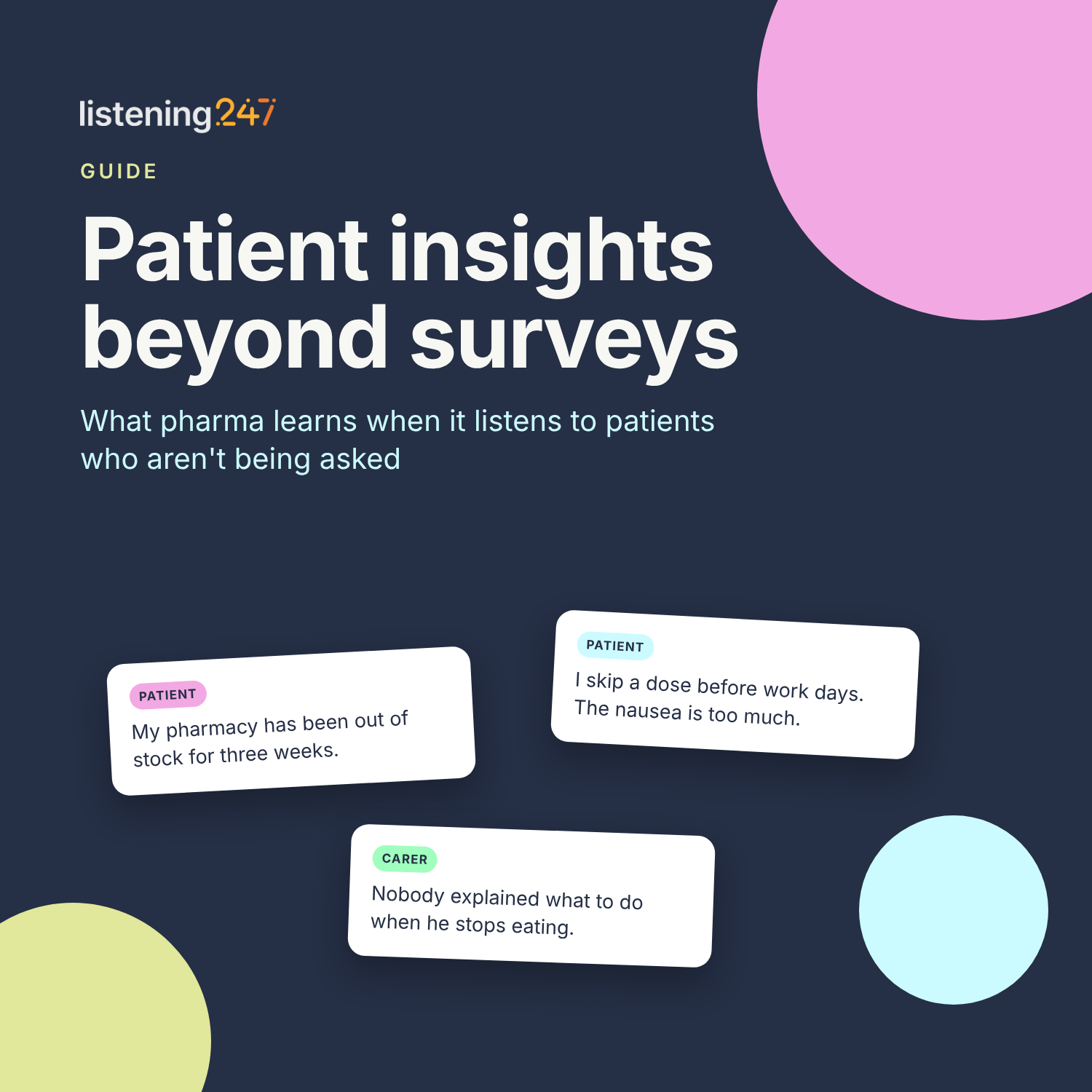
Most pharma teams learn about patients through surveys, interviews, advisory boards and patient support programmes. These methods are valuable, but they share one limit: they only hear the answers to the questions you ask.
Social listening adds what patients say when nobody is asking. This article looks at what each approach does well, where each one falls short, and how to combine them.

Surveys and interviews are good at measuring things you already know matter. You can size a problem, compare segments and track change over time with a structured sample.
Their limits are well known:
Online, patients talk about their condition and treatment in their own time and their own words. The topics that come up are often the ones research didn't plan for:
Carers add another layer. Partners, parents and adult children often describe the practical burden of a condition more clearly than patients do.
It finds what you didn't know to ask. New themes surface on their own, from a confusing injection device to a rumour about a competitor.
It's continuous. Conversations react within hours to a trial readout, a supply problem or a news story, so you see shifts as they happen.
It uses their words. Patients rarely say "gastrointestinal tolerability". They say "I felt sick for a week". That language makes patient materials, messaging, organic posts and ads more effective.
It reaches small communities. In rare diseases, patient forums and groups are often where the most detailed conversations happen.
Listening can't tell you what people think of a product that isn't on the market yet, because nobody is talking about it. For that, you still need surveys, interviews and concept tests.
Listening and research work best as a pair:

listening247 runs always-on programmes for each of your therapeutic areas and brands. Patients, HCPs and carers are analysed separately, with insight reports and recommendations at the cadence you prefer. Every possible adverse event is confirmed by an analyst and escalated to your pharmacovigilance team on your timelines, with a full audit trail.
Read our full guide to social listening for pharma or our guide to adverse events in social media listening, or see what patients are saying about your brand with a free brand snapshot, presented in a 15-minute meeting.
For products already on the market, it answers many of the same questions, unprompted and in real time. For a product that hasn't launched, you still need surveys, interviews and advisory boards.
Often, yes. Patient communities for rare conditions tend to be small but very active, and their conversations can be more detailed than what a short survey captures.

Adverse events are the main reason pharma companies hold back from social listening. Once a post describing a possible side effect is in your data, you may be responsible for assessing it and reporting it on time. A missed report can lead to regulatory findings and serious fines, so many teams decide it is safer not to look.
That decision has a cost. It leaves marketing, insights and medical teams without one of the richest sources of unprompted patient and HCP opinion. This guide explains what counts as an adverse event online, what the rules expect, and what a process looks like that your pharmacovigilance team can sign off.
This article is general information, not regulatory advice. Always confirm requirements with your own pharmacovigilance and regulatory teams.
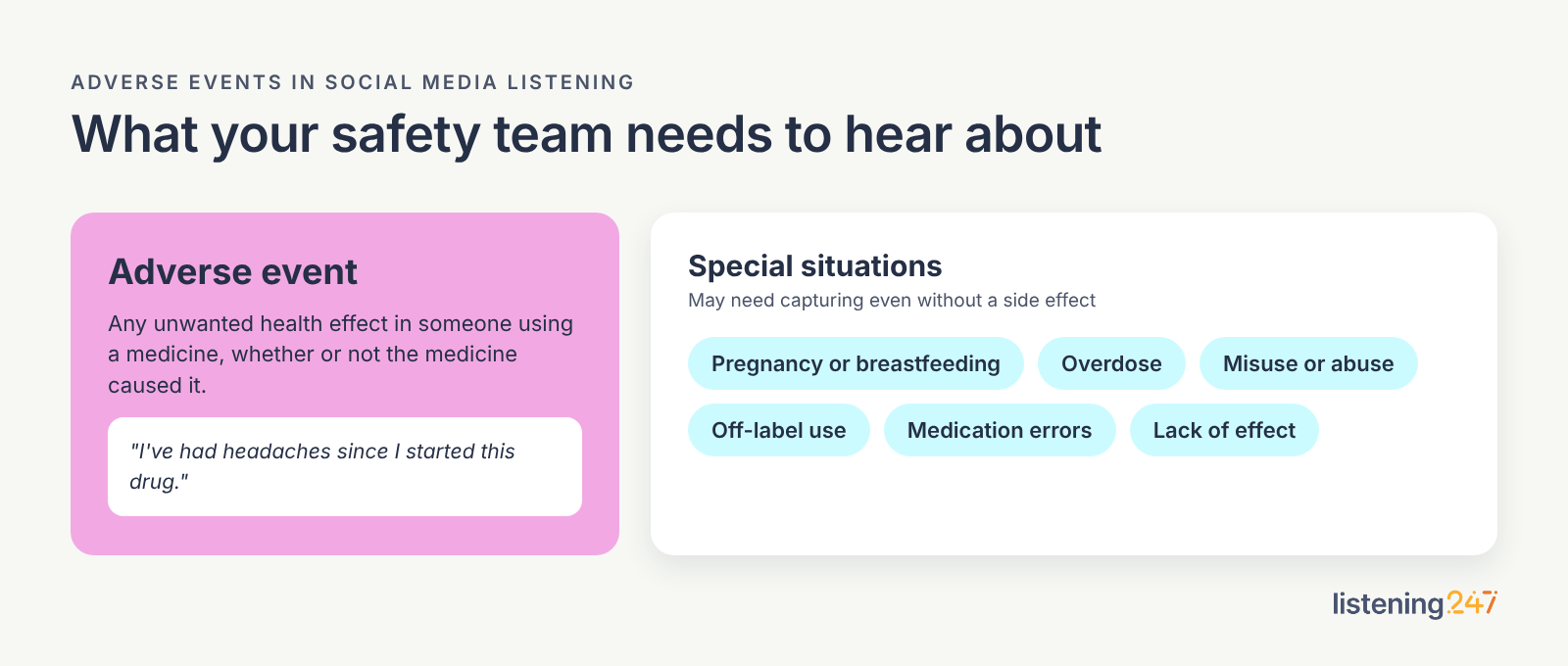
An adverse event is any unwanted health effect in someone using a medicine, whether or not the medicine caused it. A patient posting "I've had headaches since I started this drug" is describing a possible adverse event, even if the headaches have nothing to do with the drug.
Pharmacovigilance teams also care about special situations, which may need to be captured even when there is no side effect. These include:
In the EU, the European Medicines Agency's Good Pharmacovigilance Practices (GVP Module VI) says marketing authorisation holders should regularly screen the internet and digital media under their management or responsibility for possible adverse reaction reports. If they become aware of a report on a website they don't manage, it should be assessed to see whether it qualifies for reporting.
A report is only valid when it has four minimum elements:

In the EU, serious valid reports must be submitted no later than 15 calendar days after the information is first received. Other regulators, including the FDA, work on the same principle: once a company is aware of a possible adverse event, it has to assess it.
Most social media posts are anonymous or missing key details, so they don't meet all four criteria. That is reassuring, but it doesn't remove the work. Every possible adverse event still has to be checked, and the decision has to be documented.
The real challenge is volume and accuracy. A brand can generate thousands of relevant posts a week. A tool that misses adverse events creates risk. A tool that flags everything buries your safety team in false alarms. Neither is acceptable.
Avoiding social listening doesn't make adverse events disappear from the internet. Your own channels still have to be screened, and posts can still reach you through employees, agencies or customers. Meanwhile, competitors that listen properly learn what patients and HCPs think of their brand, and of yours.
The safer route is to listen with a provider that is accurate enough to trust, and a process your pharmacovigilance team has agreed in advance.
If a provider can't answer these clearly, your safety team is right to say no.
Every possible adverse event is flagged by AI, confirmed by an analyst and escalated to your safety team on your pharmacovigilance timelines, with timestamps and a full audit trail. Accuracy is written into the contract, with over 90% for adverse events, and models are retrained daily and improved with human-annotated posts whenever a mistake is spotted.
That gives your safety team the confidence to say yes, and your marketing team access to what patients, HCPs and carers are saying. Read more in our guide to social listening for pharma, or see how it works for your brand with a free brand snapshot, presented in a 15-minute meeting.
No. Only posts that meet the four minimum criteria become valid reports. But every possible adverse event you become aware of has to be assessed, and that assessment should be documented.
The marketing authorisation holder remains responsible. A listening provider flags, confirms and escalates cases so your safety team can assess and report them.
Yes, when it is accurate and backed by a documented process with human confirmation, agreed timelines and a full audit trail.
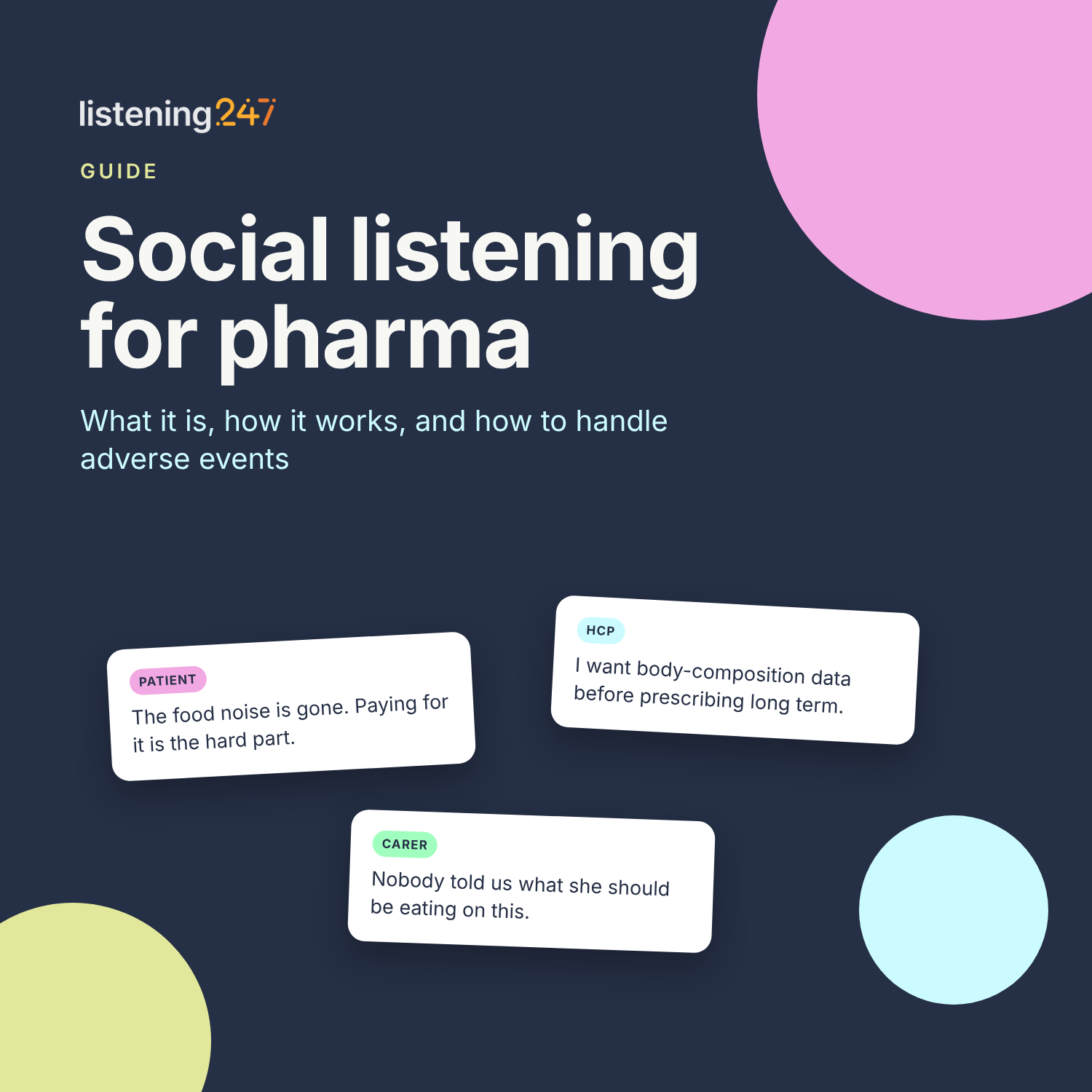
Social listening for pharma is the analysis of online conversations about diseases, treatments, brands and drugs, split by who is speaking: patients, healthcare professionals (HCPs) and carers. Done well, it tells your teams what people really think, in their own words, at the cadence you choose instead of once a quarter. Done badly, it creates compliance risk and a dashboard nobody reads.
This guide explains how it works, what makes pharma different from other industries, and what to ask before you choose a provider.
Social listening means collecting online posts from social media, forums, patient communities, blogs, reviews, news and video, then using AI and analysts to find the themes, sentiment and questions inside them.
In most industries, that is where it ends. Pharma needs three more things:
Traditional research asks people questions. Social listening hears what they say when nobody is asking. That difference matters in three ways.
It is unprompted. Surveys and interviews can only measure what you thought to ask about. Online, patients raise the problems you did not know existed: a pharmacy that keeps running out, an injection pen that is hard to use, an insurer that changed its rules.
It is continuous. Most brand teams see patient and HCP opinion through quarterly tracking studies or annual market research. Online conversation reacts within hours to a trial readout, a label change or a supply problem. Listening shows the shift while there is still time to respond.
It uses their words. Patients rarely say "gastrointestinal tolerability". They say "I felt sick for a week". Knowing the language people actually use makes messaging, patient materials, organic posts and ads more effective.
For products already on the market, listening answers many of the questions research is used for. The one thing it can't do is tell you what people think of a product that hasn't launched yet.
The most common mistake in pharma listening is treating "online conversation" as one voice. There are three main voices, and each one tells you something different.

Keeping them separate changes the conclusions. A brand can lead patient conversation and still trail with prescribers. Overall volume would hide that, because patients usually post far more than any other group.

Adverse events are the main reason pharma companies hesitate to listen. The worry is simple: once a post is in your data, you may be responsible for reporting it on time, and a missed report can lead to regulatory findings and serious fines. So many teams don't gather social media posts at all, and miss out on the marketing value.
An adverse event is any unwanted health effect in someone using a medicine, whether or not the medicine caused it. Under ICH guidelines, a report is only valid when it has four minimum elements: an identifiable patient, an identifiable reporter, a suspect product and an adverse event. Most anonymous social posts do not meet all four, but each one has to be checked.
That is not a reason to stay away. It is a reason to listen with an accurate provider and a process in place:

With that process agreed up front, listening becomes a controlled source of safety signals rather than a risk.
Social listening in pharma serves two different teams, and both need to trust it.
Marketing and insights use it to track how their brand is talked about against competitors, spot access and cost problems early, see which evidence gaps HCPs keep raising, understand what carers need, and test whether messages, organic posts and ads match the language patients use.
Pharmacovigilance needs confidence that every possible adverse event will be caught and escalated correctly. Their sign-off is what allows marketing to use social data in the first place.
General social listening tools were built for consumer brands. Before you choose one for pharma, ask:
A provider who cannot answer the second question clearly is not ready for pharma.
listening247 runs Therapeutic Area Intelligence, an always-on programme for each of your therapeutic areas and brands, run by our analysts. Patients, HCPs and carers are analysed separately, with insight reports and recommendations at the cadence you prefer. Every possible adverse event is confirmed by an analyst and escalated to your safety team with a full audit trail.
Accuracy is written into the contract: at least 80% F1 on sentiment and topics, 90% on brand relevance and over 90% for adverse events. Models are trained only for you, retrained daily and improved with human-annotated posts whenever a mistake is spotted.

The easiest way to see it is a free brand snapshot: your brand against a competitor, by audience, presented by our analysts in a 15-minute meeting.
I'm the lead author of AI Powered Insight (Routledge, 2026), on how AI is changing market research.
Yes, when personal data is kept to a minimum and anonymised, and there is a documented adverse-event process with human confirmation and escalation to your safety team.
For products already on the market, it answers many of the same questions, unprompted and in real time. For a product that hasn't launched, you still need surveys, interviews and advisory boards.
Yes. Many HCPs post on social networks, blogs and forums, and some professional communities can be included when you give us access.
Most teams start with a free snapshot of their brand against a competitor, presented in a 15-minute meeting. Then we talk through what an always-on programme would look like for your therapeutic areas.

Social listening, sometimes called social media listening, is the practice of tracking and analysing public online conversations to understand what people say about a brand, product, or industry across social media, forums, blogs, and news.
It goes beyond simply tracking mentions or counting likes. At its core, social listening is about understanding the intent, sentiment, and context behind what people say online, then using that understanding to inform business decisions.
A straightforward definition: social listening is the process of collecting and analysing public online conversations to extract actionable insights about your audience, your brand, and your market.
These two terms are often used interchangeably, but they describe different activities.
Social monitoring is reactive. It tracks specific mentions, hashtags, or keywords and alerts you when they appear. It answers the question: what is being said?
Social listening is strategic. It analyses patterns, trends, and sentiment across a much broader dataset to answer a deeper question: what does it mean, and what should we do about it?
Think of monitoring as reading individual messages and listening as understanding the full conversation.
Most modern social listening platforms combine both capabilities, but the strategic value comes from the listening layer, not the monitoring layer.
Social listening platforms operate through a combination of data collection, natural language processing, and sentiment analysis.
The platform continuously crawls and ingests data from connected sources. These typically include major social networks such as Facebook, Instagram, X (formerly Twitter), LinkedIn, YouTube, and TikTok, as well as forums like Reddit, blogs, news publications, and review sites. The volume of data processed is enormous. A single platform may analyse millions of posts per day across dozens of languages.
Raw social data is noisy and unstructured. Natural language processing (NLP) is the technology that makes sense of it. NLP models identify the topics being discussed, classify the language used, detect sarcasm and nuance, and group related conversations together. This is what separates a useful insight from a wall of irrelevant text.
Sentiment analysis classifies the emotional tone of a conversation. Is this post positive, negative, or neutral? Is the author frustrated, excited, or confused? Advanced sentiment models go further, identifying specific emotions, urgency signals, and purchase intent within conversations.
Once data is collected, processed, and classified, the platform presents it in a usable format. This might be a dashboard showing trending topics, a report on brand sentiment over time, an alert when a crisis is emerging, or a breakdown of what your audience cares about most in a given week.
The applications of social listening span almost every business function. Here are the most common and valuable use cases.
Understanding how your brand is perceived in the market is fundamental. Social listening gives you a real-time view of brand sentiment, share of voice relative to competitors, and how that perception shifts in response to campaigns, news events, or product changes.
You can apply social listening to any brand, not just your own. Monitoring competitor conversations reveals what their customers love, what they complain about, and where there are gaps in the market your brand can occupy.
Social listening surfaces emerging trends before they reach mainstream media. Brands that identify a trend early have a significant advantage in terms of content creation, product development, and campaign positioning.
The language your audience uses, the topics they care about, the questions they ask and the frustrations they express are all visible in social data. This is some of the richest audience intelligence available, and it updates continuously without the need for surveys or focus groups.
Social listening provides a real-world measure of how a campaign is being received. Beyond impressions and clicks, it tells you whether your message is resonating, being misunderstood, or generating unintended associations.
When sentiment drops sharply or a negative topic spikes suddenly, social listening platforms can trigger alerts that give brands a critical window to respond before a situation escalates. Speed of response is often the determining factor in how a brand crisis plays out.
Consumers regularly discuss product problems, feature requests, and unmet needs in public forums. Social listening transforms that feedback into a structured input for product development teams.
The volume of online conversation has grown exponentially over the past decade, and so has its influence. A single viral post can shift brand perception overnight. A trend that starts on TikTok can be mainstream within 72 hours. A product complaint shared on Reddit can reach tens of thousands of people before a brand's customer service team even sees it.
In this environment, brands that are not actively listening are operating with a significant blind spot. They are making marketing decisions based on historical data, internal assumptions, and periodic research rather than the live, unfiltered signal that is available to them at any moment.
Social listening closes that gap. It gives marketing, communications, and product teams access to a continuous stream of real-world intelligence that improves the quality of every decision they make.
There is also a growing relevance for AI-powered marketing workflows. Most social listening tools stop at insight. They tell you what your audience thinks but leave the gap between understanding and action entirely in your hands. That gap is where most of the value gets lost. Brands receive a report, hold a meeting, brief an agency, and by the time creative is produced the trend has moved on.
The most advanced implementations of social listening close that gap entirely. As brands increasingly use AI to generate content and advertising creative, social listening provides the richest possible input: real conversations, real language, real intent, sourced directly from the audiences brands are trying to reach. For Shopify merchants, DataVinci takes this further by turning social listening data directly into on-brand ad creative. No brief, no agency, no lag. It is the only tool that moves from insight to action in a single workflow.
Understanding social listening means understanding the metrics that platforms use to quantify what they find.
Share of voice measures the proportion of total online conversation in your category that mentions your brand versus competitors. It is expressed as a percentage and gives a clear picture of brand visibility relative to the market.
Net Sentiment Score® is a measure of overall brand sentiment calculated by subtracting the percentage of negative mentions from the percentage of positive mentions. A score above zero indicates net positive perception. listening247 coined the methodology and trademarked the name Net Sentiment Score®, which has since been peer-reviewed and published in academic literature, providing a more reliable and independently validated measure than simple positive/negative ratios.
The raw count of how many times a brand, product, or topic is mentioned within a given time period. Volume alone is rarely meaningful but is useful in context, particularly when tracking spikes that indicate news events, viral moments, or emerging issues.
A breakdown of mentions by emotional classification: positive, negative, neutral. More advanced platforms add secondary layers such as emotion type (joy, anger, surprise) or intent signals (purchase intent, churn risk).
A categorisation of what is being discussed. For a consumer brand, this might show that 40% of conversations relate to product quality, 25% to customer service, 20% to price, and 15% to packaging. This distribution is a map of what your audience actually cares about.
Beyond the mention itself, reach measures how many people potentially saw a piece of content. Engagement measures how many interacted with it. These metrics help distinguish between a high-volume low-impact conversation and a lower-volume high-influence one.
Social listening is not sector-specific. The underlying methodology applies wherever public online conversation exists, but the applications vary by industry.
For FMCG brands, otherwise known as CPG (consumer packaged goods), social listening tracks product reception, monitors retailer conversations, identifies emerging consumer trends, and provides early warning of product quality issues before they reach customer service queues.
Fashion brands use social listening to track trend cycles, monitor influencer-driven conversation, measure the impact of drops and campaigns, and understand how brand positioning is perceived across different audience segments.
In a heavily regulated sector where brand trust is everything, social listening provides a real-time measure of customer sentiment and flags reputational risks early. It is also used to monitor competitor positioning and regulatory discussions.
Audience sentiment tracking, content reception monitoring, and talent perception analysis are all standard applications for media companies with active social audiences.
Multi-client agencies use social listening platforms to manage brand intelligence across multiple accounts simultaneously, generating insights and creative briefs from audience data rather than assumptions.
Not all platforms are equal. When evaluating social listening tools, the following criteria matter most.
Data coverage: Which sources does the platform monitor? The breadth of data collection directly determines the quality of insights. A platform that covers only Twitter and Instagram will miss significant conversation happening on Reddit, YouTube, and forums.
Language support: If your audience is global, you need a platform that analyses sentiment and topics accurately across multiple languages, not just English.
Sentiment and topic accuracy: Sentiment and topic classification are harder than they look. Sarcasm, colloquialisms, and industry-specific language all challenge generic models. Look for platforms that publish accuracy benchmarks and offer industry-specific model tuning. A credible platform should commit to a minimum 80% F1-score for both sentiment and topic accuracy across any language. Separately, brand accuracy (sometimes called relevance) measures how much of the data collected actually relates to your brand rather than irrelevant noise caused by homonyms and ambiguous terms. Look for platforms that achieve over 90% relevance, as high noise levels make insights unreliable regardless of how accurate the sentiment model is.
Real-time capability: For crisis monitoring and trend detection, the speed of data ingestion matters. Some platforms operate on a 24-48 hour delay. Others provide near real-time data.
Insight depth: Can the platform tell you not just what is being said but why, and by whom? Audience segmentation, topic clustering, and intent detection separate basic monitoring tools from genuine intelligence platforms.
Output and integration: How does the platform present its findings? Can it connect to your existing workflows, reporting tools, or content production systems?
As covered earlier, monitoring and listening are related but distinct. Monitoring is about catching mentions. Listening is about understanding meaning. The two are often bundled together but should not be treated as synonymous.
Social listening is valuable at any scale. Even a brand with modest mention volumes benefits from understanding the sentiment and themes within those conversations. And listening to competitor and category conversations provides market intelligence that is entirely independent of your own brand's mention volume.
Raw social data is noisy, and homonyms are a particular problem. A brand name that shares a word with common everyday language will pull in enormous volumes of irrelevant content. But this is a platform quality problem, not an inherent limitation of social listening. Well-built platforms use advanced NLP and relevance filtering to produce clean, reliable datasets, committing to minimum accuracy benchmarks rather than leaving it to chance. listening247 commits to a minimum 80% F1-score for sentiment and topic accuracy in any language, and over 90% brand relevance, both validated against third-party benchmarks.
Social listening complements rather than replaces traditional research methods. What it offers is speed, scale, and unprompted honesty. Survey respondents know they are being studied. Social media users do not. That changes what they say and how they say it.
If you are new to social listening, the most effective way to start is by defining a clear scope before selecting a platform.
Start with these questions: What brand or product do you want to monitor? Who are your main competitors? What topics or themes are most strategically important to your business? What would you do differently if you had better audience intelligence?
The answers shape your listening strategy and prevent the common mistake of collecting vast amounts of data without a clear plan for acting on it.
Once you have defined your scope, set up your brand monitoring first, then layer in competitor tracking, then category and trend listening. Build from specific to broad rather than trying to monitor everything at once.
Review your first reports critically. Look for surprises. The most valuable social listening insights are almost always the ones you did not expect.
Social listening is one of the most powerful and underused tools available to modern marketers. It provides a direct, continuous feed of real-world intelligence about your brand, your audience, and your market, sourced from the conversations people are already having.
The brands that use it well do not just react faster. They make better decisions, create more relevant content, build stronger products, and understand their audiences in a way that no other research method can replicate.
If you are not listening, your competitors might be.
Most business merchants know the feeling. A post needs to go out. Something gets written, published, and hoped for. Maybe it lands. Maybe it doesn't. Either way, the same process repeats next week.
That’s not a content strategy. It’s survival mode. And it’s costing merchants more than they realise.
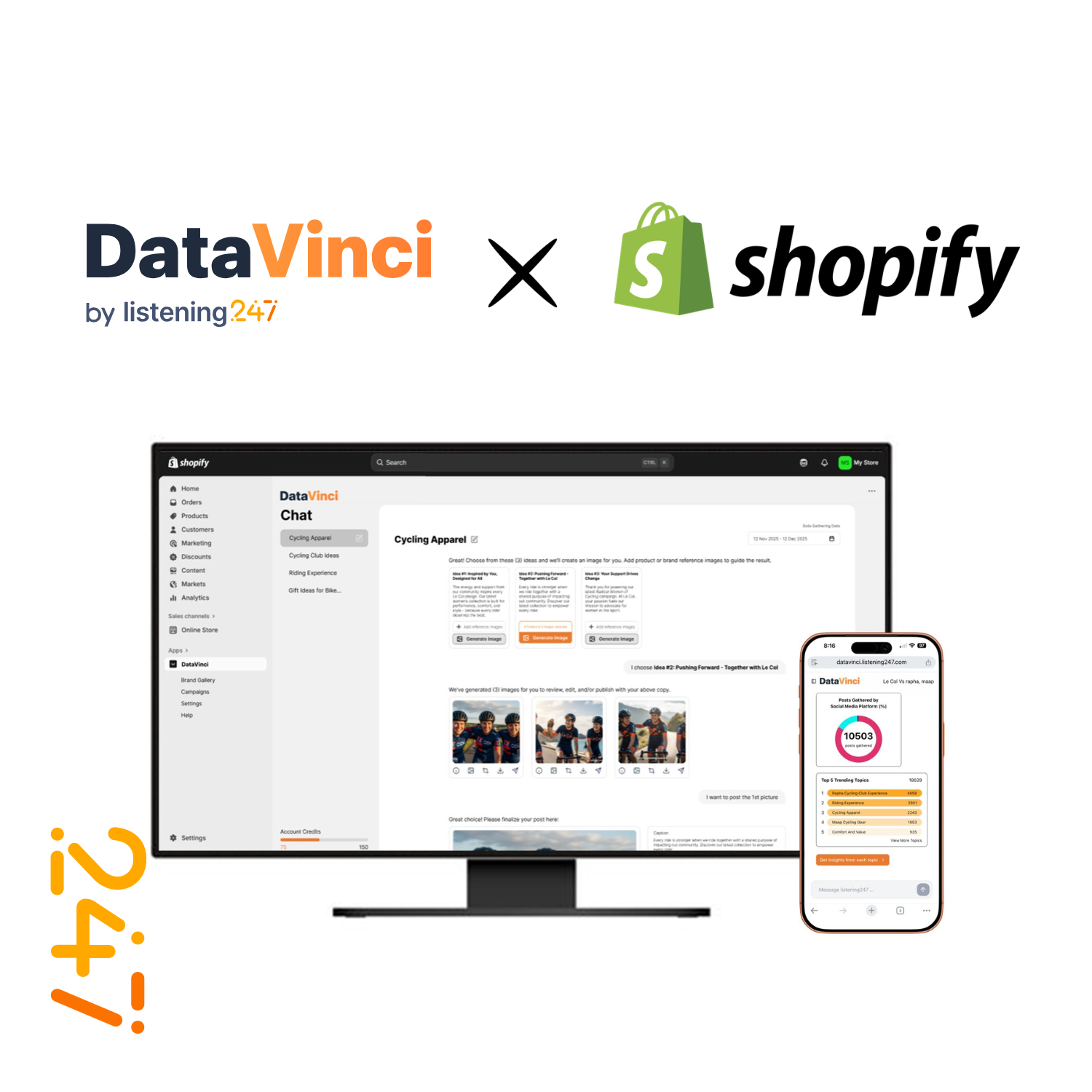
When listening247 took a look at how small to medium size businesses operated, how they typically created social media content, and where they were doing business, we knew we needed to take our web app of DataVinci and build it directly into Shopify.
So what is it? DataVinci is AI-Powered Social Campaign Automation for Shopify Merchants. It listens to real customer and competitor conversations while using your Shopify store data to turn conversations into content that actually connects.
Generic AI tools help with speed. But they still depend on the user knowing what to write about before anything gets created. The guesswork never actually goes away.
DataVinci works differently. It surfaces the top themes your audience actually cares about, then instantly generates campaign ideas, post captions, and images ready to publish. This is listening-to-ads. From real customer conversations to targeted social content, automatically.
The result is content built on insight, not instinct.
Everything Needed to Scale a Digital Presence
DataVinci is built to handle the full content workflow all within the Shopify interface so you don’t have to jump around your browser:
Bulk content generation. Create weeks of content in minutes. Generate multiple images and copy ideas at once, each tailored to different themes and customer insights.
Brand voice and style control. Set the brand's tone, visual style, and content guidelines once. Every post stays perfectly on-brand, automatically.
Multi-platform scheduling. Schedule to Instagram, Facebook, and X. Optimize timing for each platform without juggling multiple tools.
The difference shows up fast. Merchants in early testing are seeing real, measurable results:
10x faster output. Weeks of content created in minutes.
3x current ROAS. Content built from real customer conversations speaks directly to what audiences care about. That translates into double the return on ad spend.
90% lower creative costs. No agency. No freelancer. Just intelligent, high-performing content generated at scale.
DataVinci is launching on Shopify soon. A free forever plan will be available, making it possible for any merchant to get started with no upfront commitment.
Right now, a limited number of beta spots are open. This is the opportunity to get early access, shape the product with real feedback, and start creating content that actually performs before the full launch.
Beta testers get in first. Spots are limited.
Sign up for the beta waitlist: https://www.listening247.com/datavinci

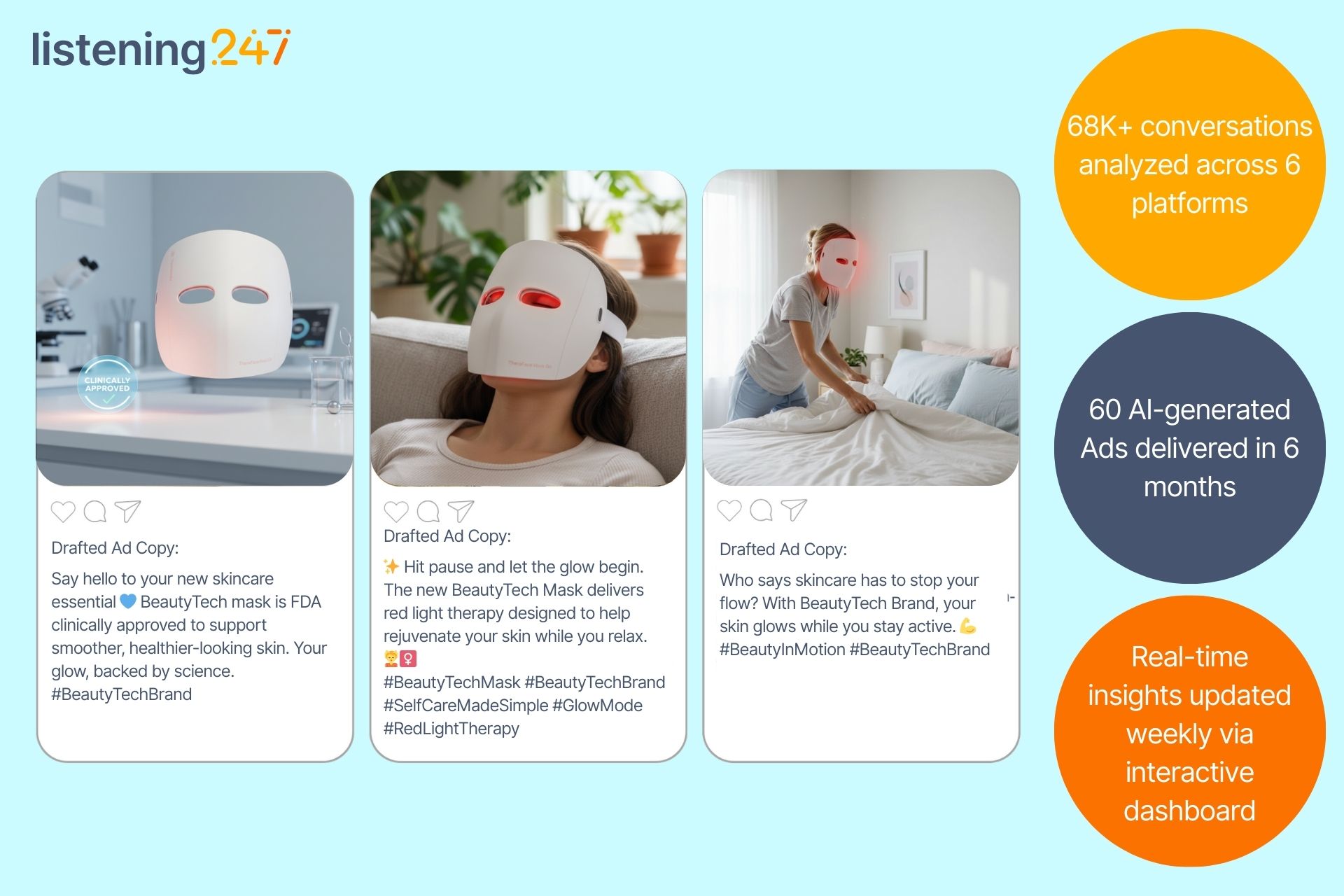
A leading Beauty Tech Brand partnered with listening247 to leverage AI-powered market intelligence and ad automation to guide brand positioning and 2026 campaign planning. This was achieved by gathering actionable consumer insights and campaign inspiration through monitoring global conversations about the brand, its competitors, and the broader wellness and beauty tech categories.
The Beauty Tech Brand wanted to understand how their brand was perceived globally compared to competitors and identify common themes within the wellness and beauty tech space. They required a scalable solution to analyze up to 68K+ posts over six months from diverse sources including social media, blogs, forums, and news.
listening247 deployed its proprietary AI engine, DataVinci, to gather and analyze real-time conversations in English across multiple platforms (Facebook, YouTube, TikTok, Instagram, X, Reddit, blogs, forums, reviews, news articles). DataVinci tagged conversations by brand, theme, and sentiment to uncover drivers of consumer perception and competitive positioning.


In the current noisy digital landscape, brands are constantly searching for new ways to connect with audiences and stand out in crowded markets. While traditional data and analytics, such as surveys and focus groups, have long been the backbone of marketing, there is a vast and often overlooked resource that holds the key to breakthrough ad concepts: everyday customer conversations.
At listening247, we believe the real power lies in mining these authentic interactions. Whether they happen on social media, review sites, or forums, these dialogues contain untapped insights that can transform your entire campaign strategy.
Traditional market research and surveys provide valuable information but are structured to provide long term, strategic benchmarks. However, they often miss the nuance and immediacy of real time dialogue. Conversations reveal not just what customers think, but how they feel and the specific language they use when discussing their problems. It’s dynamic.
This rich and unfiltered data is a goldmine for brands looking to create ads that truly resonate. When you understand the exact words and emotions your customers express, you can craft messages that cut through the noise and build genuine trust.
The challenge for many brands is how to efficiently capture and analyze the sheer volume of interactions happening every day. This is where AI powered platforms like listening247 come into play.
Our technology listens to thousands of online conversations to identify recurring themes and emerging trends. By transforming this raw data into hundreds of ready to run ad ideas, brands can rapidly test and deploy campaigns that reflect what customers are actually saying.
Imagine turning five core themes from your customer conversations into over 250 unique ad angles in just minutes. This scale and speed allow marketers to experiment and find the messages that truly move the needle.
Mining customer conversations offers several key benefits for modern brands:
While all business sizes and industries have this need to understand their customer better, small and mid sized businesses often face resource constraints that limit their ability to conduct deep market research. Using AI to automate the extraction of insights and generate creative concepts levels the paying field.
At listening247, we empower SMBs to harness their customers’ voices at scale. We turn everyday conversations into high-performing digital ads tailored for social media and other digital platforms by analyzing customer language, sentiment, and emerging trends to craft messages that drive engagement and sales. This approach not only drives better campaign performance but also builds stronger and more loyal customer relationships.
As we move further into 2026, the brands that succeed will be those that listen first and act fast. Customer conversations will become less of background noise and be a primary source of ideation. They will be the foundation of a successful marketing strategy.
Unlocking this hidden goldmine requires the right tools and a commitment to listening. By embracing conversational insights and AI driven automation, brands can create breakthrough ads that resonate deeply and deliver measurable results.
Are you ready to turn your customer conversations into your most valuable marketing asset?

In this podcast, Tom Griffiths, Founder and CEO of Synergy CFO Solutions, interviews Michalis A. Michael, Co-founder and CEO of listening247. They explore how listening247 analyzes real online customer conversations and leverages AI to generate ad prompts and campaign ideas, helping small and mid-sized businesses break through the creative bottleneck.
Listen Now On: YouTube
P.S. Have questions about the podcast? Contact us at: info@listening247.com. We’re happy to help!

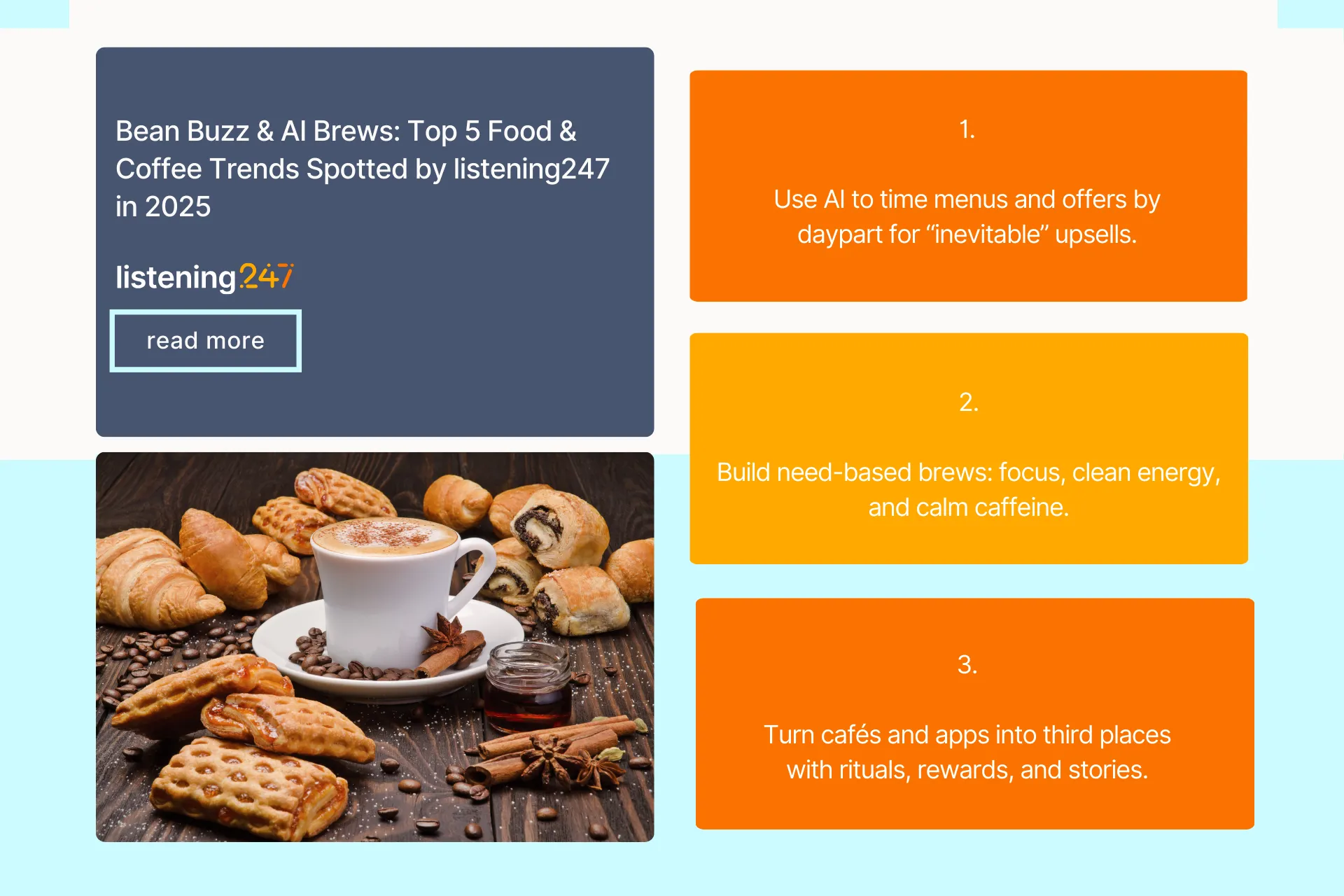
In food and coffee today, taste isn’t just on the tongue; it’s social, ritual, and smart.
From AI curated menus to functional brews, these are the top 5 trends shaping how people sip, snack, and share in 2025 across the UK, EU, and US.
listening247’s analysis of 47,000+ conversations from the second half of 2025 across X, Instagram, TikTok, Reddit, forums, and blogs reveals five key topics driving category discussion in coffee and food service:
Product innovation leads, reflecting a rising demand for specialty coffee, clean-label ready-to-drink (RTD) beverages, and playful flavor mashups. Coffee chains (for example, Starbucks, Costa, Pret) and specialty roasters are also innovating by using AI to personalize menus, forecast demand by daypart, and refine data-led marketing.
STRATEGIC TAKEAWAY: The better you know your customer, the easier it is to target them. Understanding micro moments (morning rush vs. afternoon slump), flavor tribes (nutty chocolate vs. bright citrus), and value signals (sustainability, wellness) turns broad audiences into highly targetable segments with higher conversion and loyalty.
Coffee chains and specialty roasters are adopting machine learning to:
Why it matters: precision targeting. When you know who buys what, when, and why, you tailor offers that feel inevitable, boosting attach rates and repeat orders.
Consumer talk around “focus,” “clean energy,” and “no jitters” is climbing across Reddit and TikTok. We see momentum for:
Strategic takeaway: segment by need (deep work mornings, gym pre or post, gentler PM pick me ups) rather than by demographic alone.
The “best taste” is emotional and digital. Loyalty apps and order ahead options are baseline; leaders differentiate with:
Strategic takeaway: map journeys by social channel and moment. For example: use TikTok to drive discovery with short-form content, then direct viewers to a free trial or introductory offer in your app. In-store, reinforce this with QR codes at the counter that capture feedback and unlock a discount, which you then use to tailor an ongoing subscription offer.
Coffee is culture; it anchors routines, identity, and “third place” belonging. A third place is a social space outside home (first place) and work (second place), where people feel comfortable, recognised, and part of a community.
Coffee spaces and rituals contribute to that sense of belonging through:
Strategic takeaway: lifestyle markers (remote work, fitness communities, eco conscious shoppers) predict beverage and food attach rates better than age brackets.
High-impact promotions do more than discount offers; they layer in story, exclusivity, and participation so customers feel part of something, not just getting a lower price:
Strategic takeaway: AI amplifies what resonates, optimizing message, audience, and timing across X, Instagram, and TikTok. The result: casual sippers become community members.
Across 47,000+ conversations from the second half of 2025 the UK, EU, and US coffee and food landscape is thriving at the intersection of craft and code. Brands that deeply understand customers, by moment, mindset, and micro culture, can target with precision, personalize at scale, and build communities where the “best brew” is sensory, digital, and deeply human.

Michalis A. Michael, Founder & CEO of listening247 and lead author of the book AI Powered Insight (Routledge, 2026), will chair the Market Research Society’s one‑day conference on 22 January 2026 and deliver the extended opening address. He will speak about themes from his book, practical frameworks and case studies showing where AI adds real value to research and where human judgement must stay central, which is a key reason MRS invited him to lead the day. Expect a focused, evidence‑led programme shaped by that perspective.
Date: Thursday 22 January 2026
Venue: Radisson Blu Edwardian, Bloomsbury Street, London
Full programme & booking: MRS — AI: Powering‑Up Insights Conference 2026
Michalis A. Michael, Founder & CEO of listening247 and lead author of the book AI Powered Insight (Routledge, 2026), will be a featured speaker at the Text Analytics Forum in Washington DC on 19 November 2025. He will share practical insights on how AI-driven text analytics is transforming business intelligence, highlighting real-world case studies and frameworks that balance AI innovation with human expertise. His session promises actionable takeaways for professionals navigating the evolving landscape of text analytics.
Date: Tuesday19 November 2025
Venue: Washington Marriott Georgetown, Washington DC
Full programme & booking: Text Analytics Forum 2025

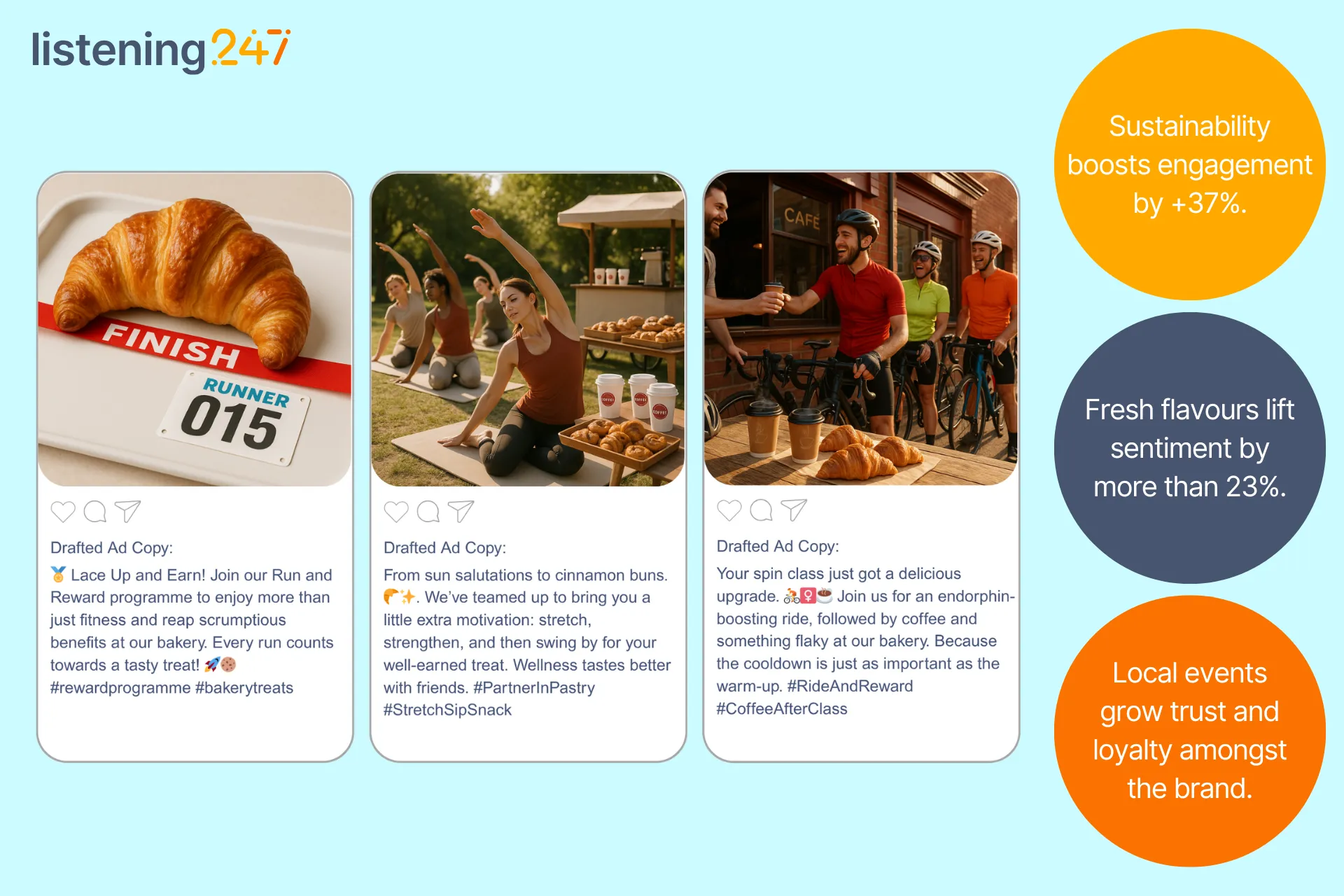
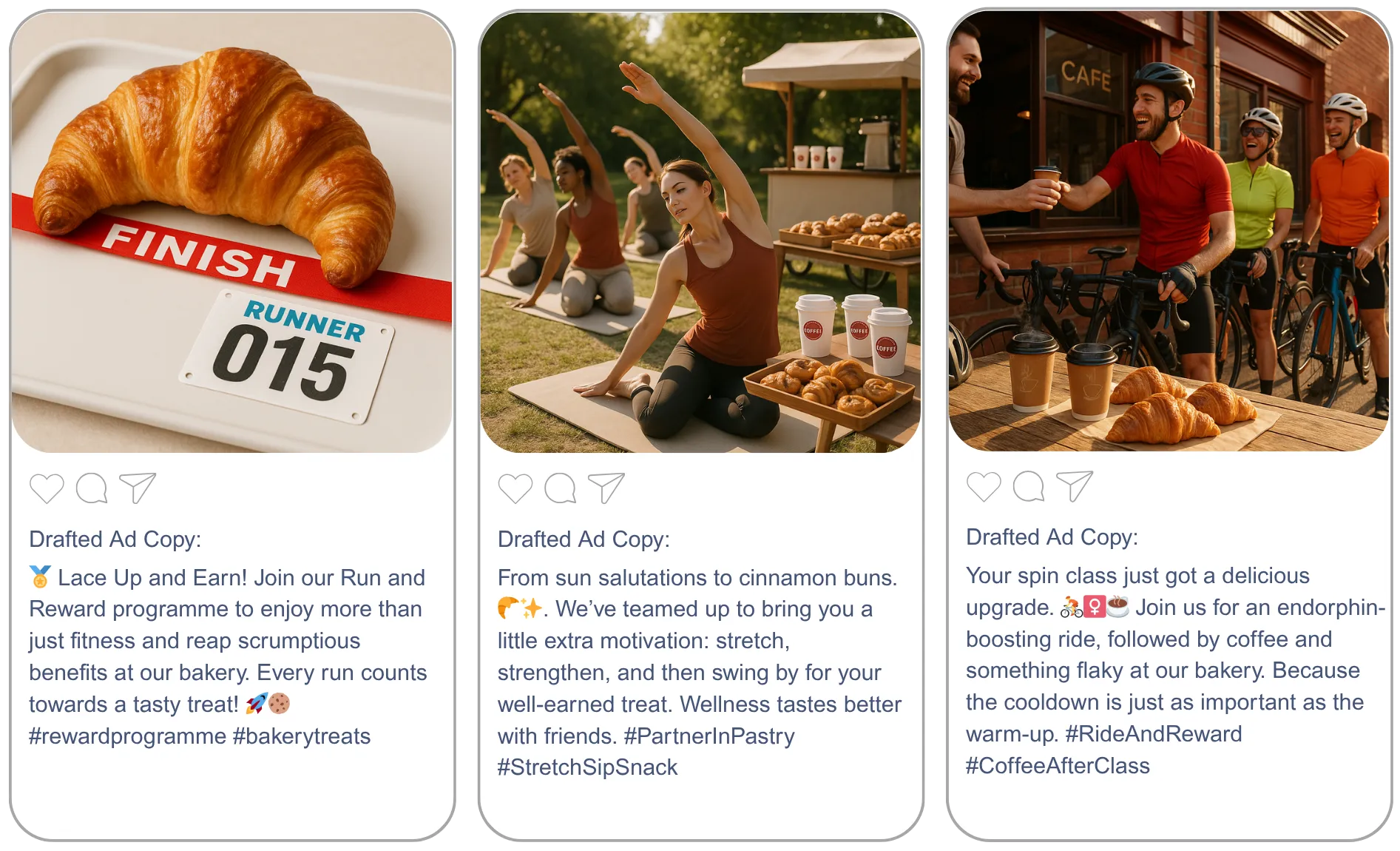
listening247 reveals key insights into how coffee and bakery brands monitor their social presence and drive smart marketing decisions by:

Using its proprietary Gen AI model, l247
Based on identified conversations, L247 used its proprietary Gen AI model to create copy an imagery for ads:

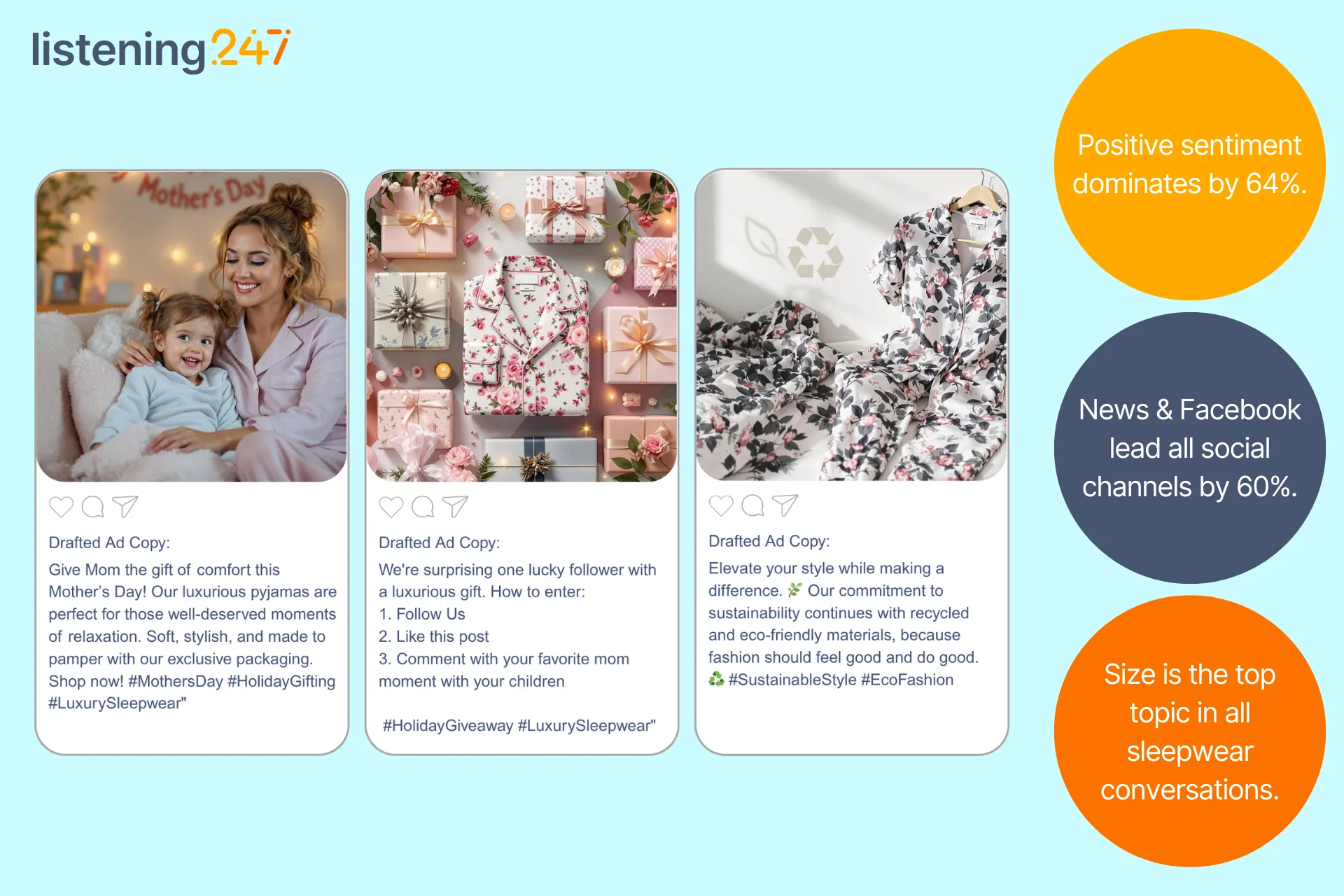
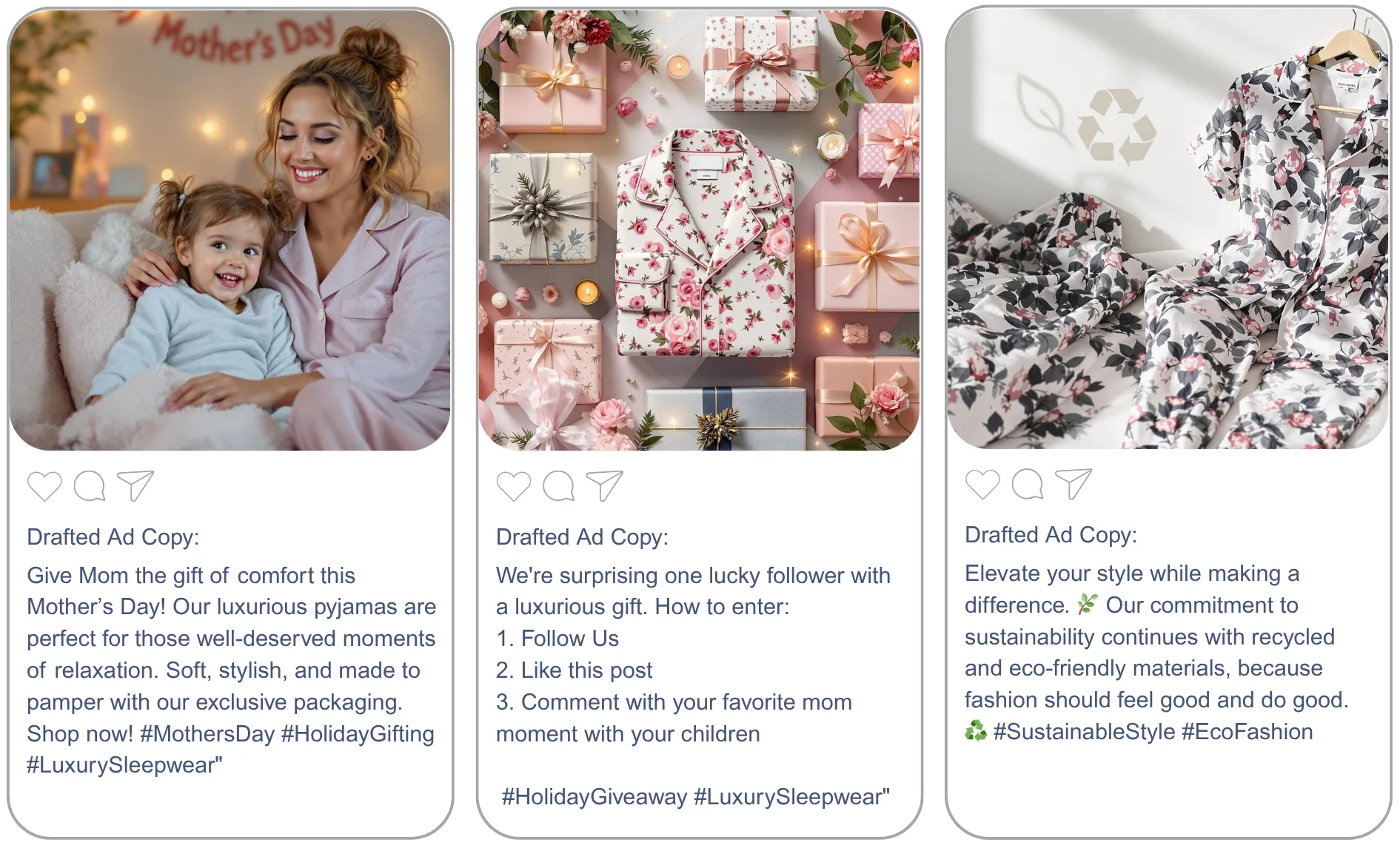
listening247 uncovered valuable insights about how brands in the sleepwear industry track their social presence and make informed marketing decisions by:
Using its proprietary Gen AI model, l247
Based on identified conversations, L247 used its proprietary Gen AI model to create copy an imagery for ads:

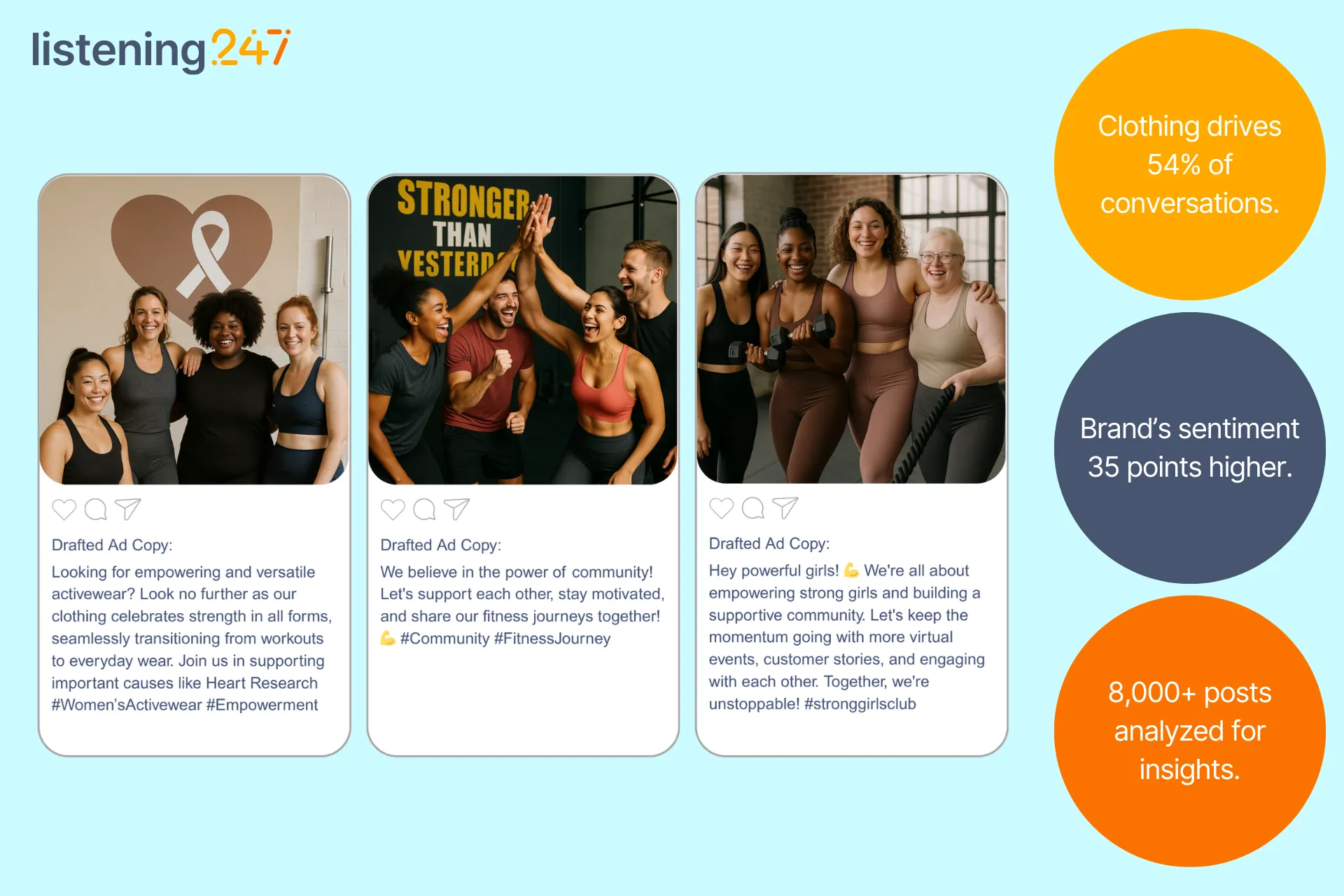
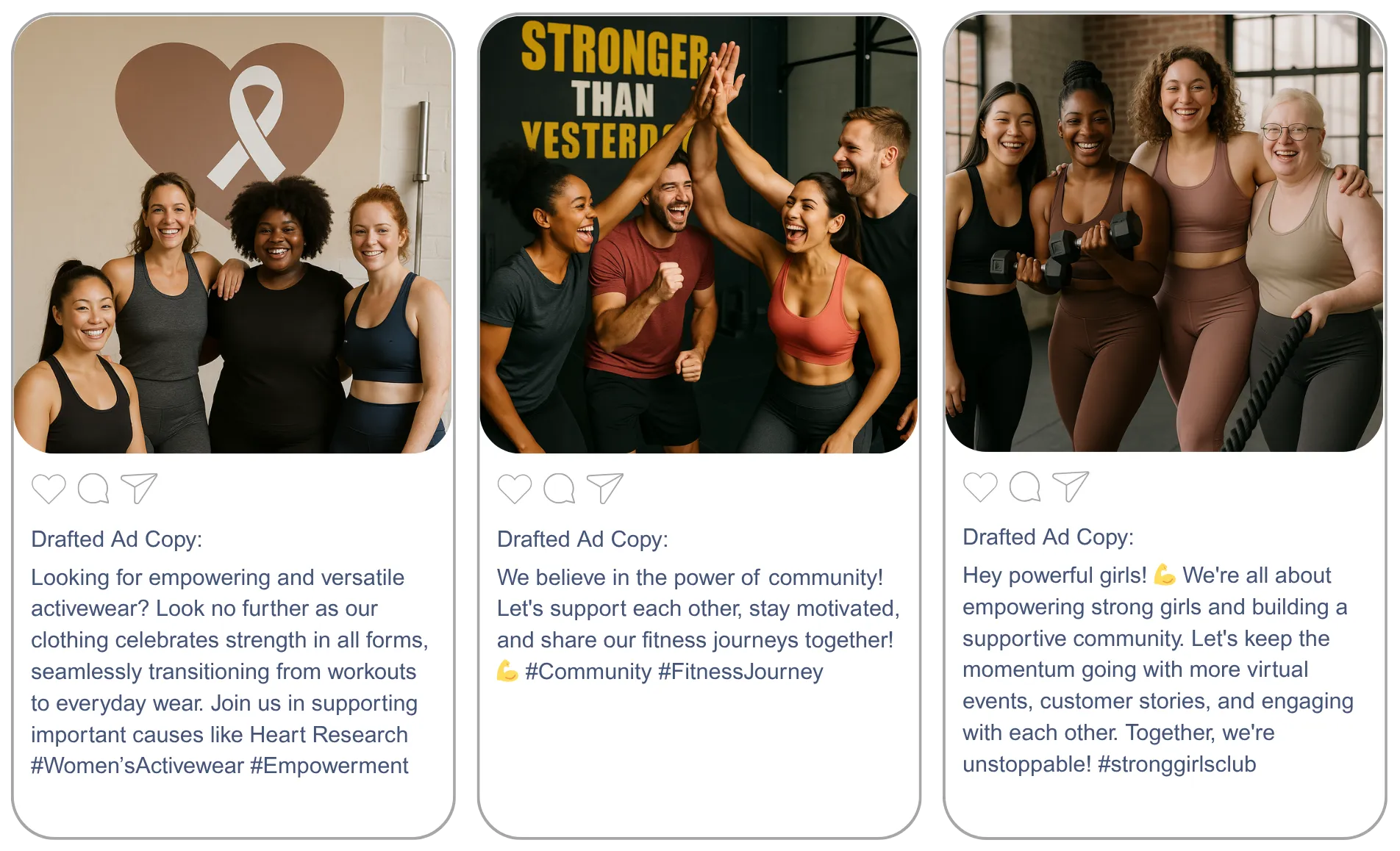
listening247 created insight reports for the women’s activewear industry to:
Using its proprietary Gen AI model, l247
Based on identified conversations, L247 used its proprietary Gen AI model to create copy an imagery for ads:

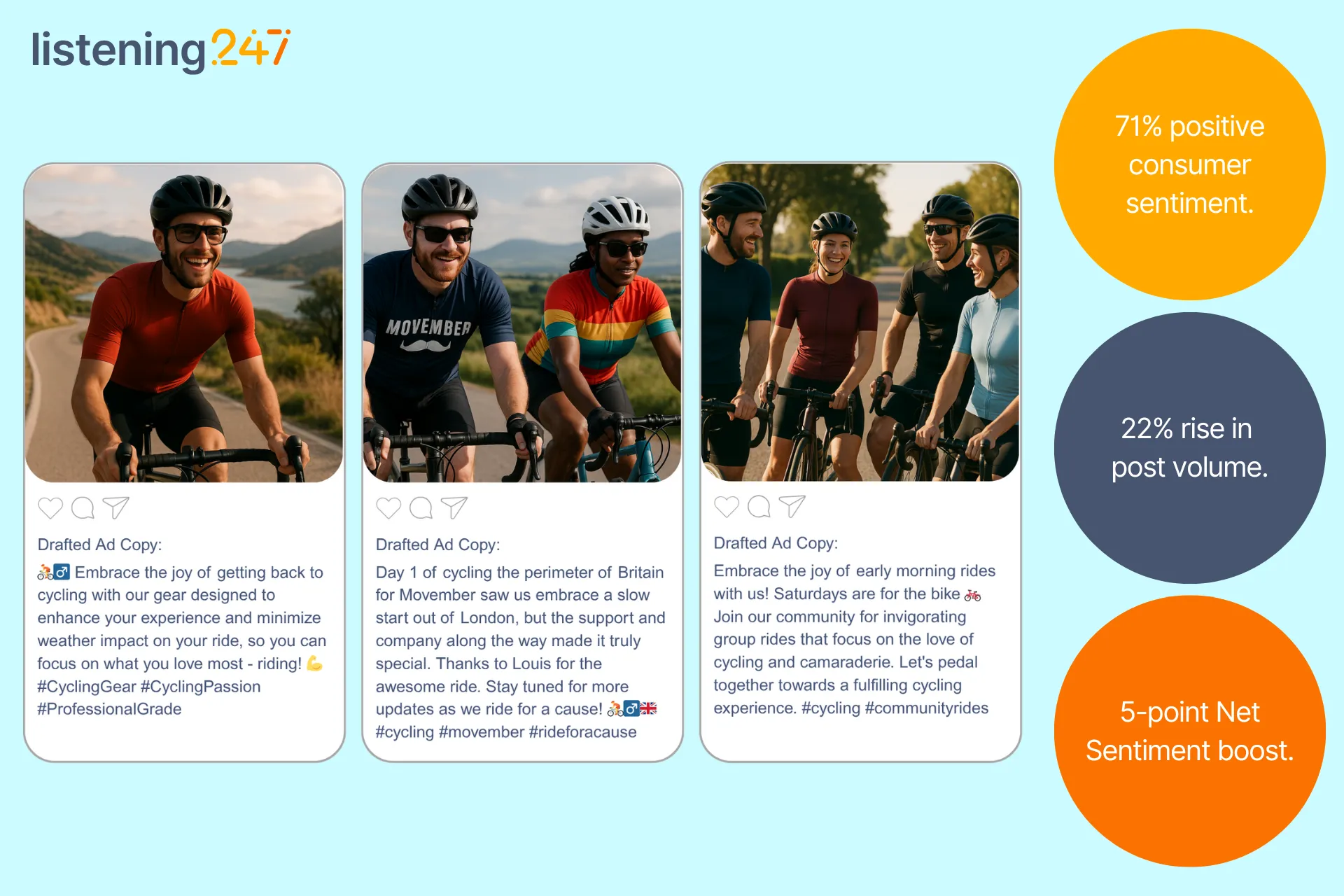
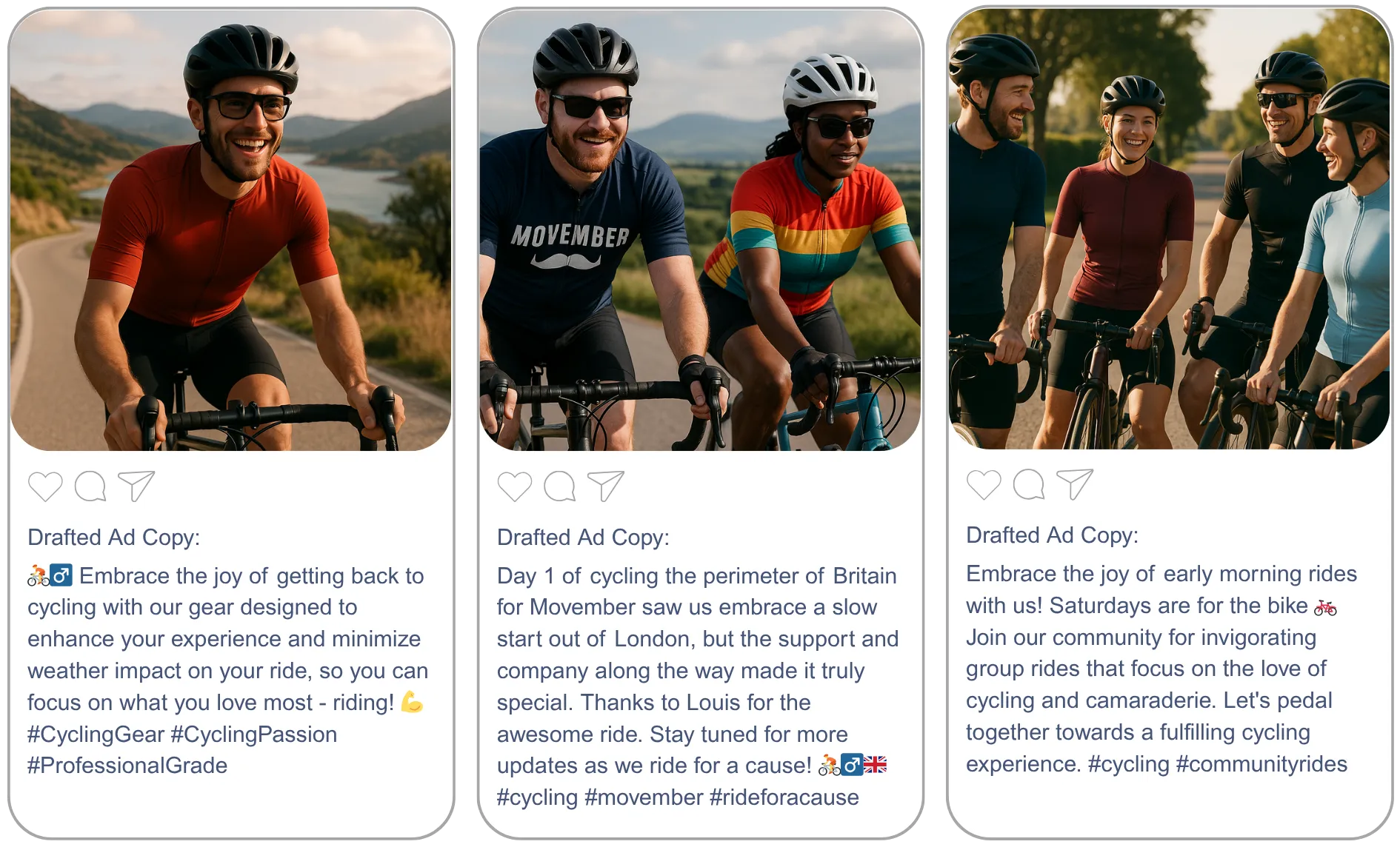
listening247 creates frequent insight reports for a cycling brand to:
Using its proprietary Gen AI model, l247
Based on identified conversations, L247 used its proprietary Gen AI model to create copy an imagery for ads:

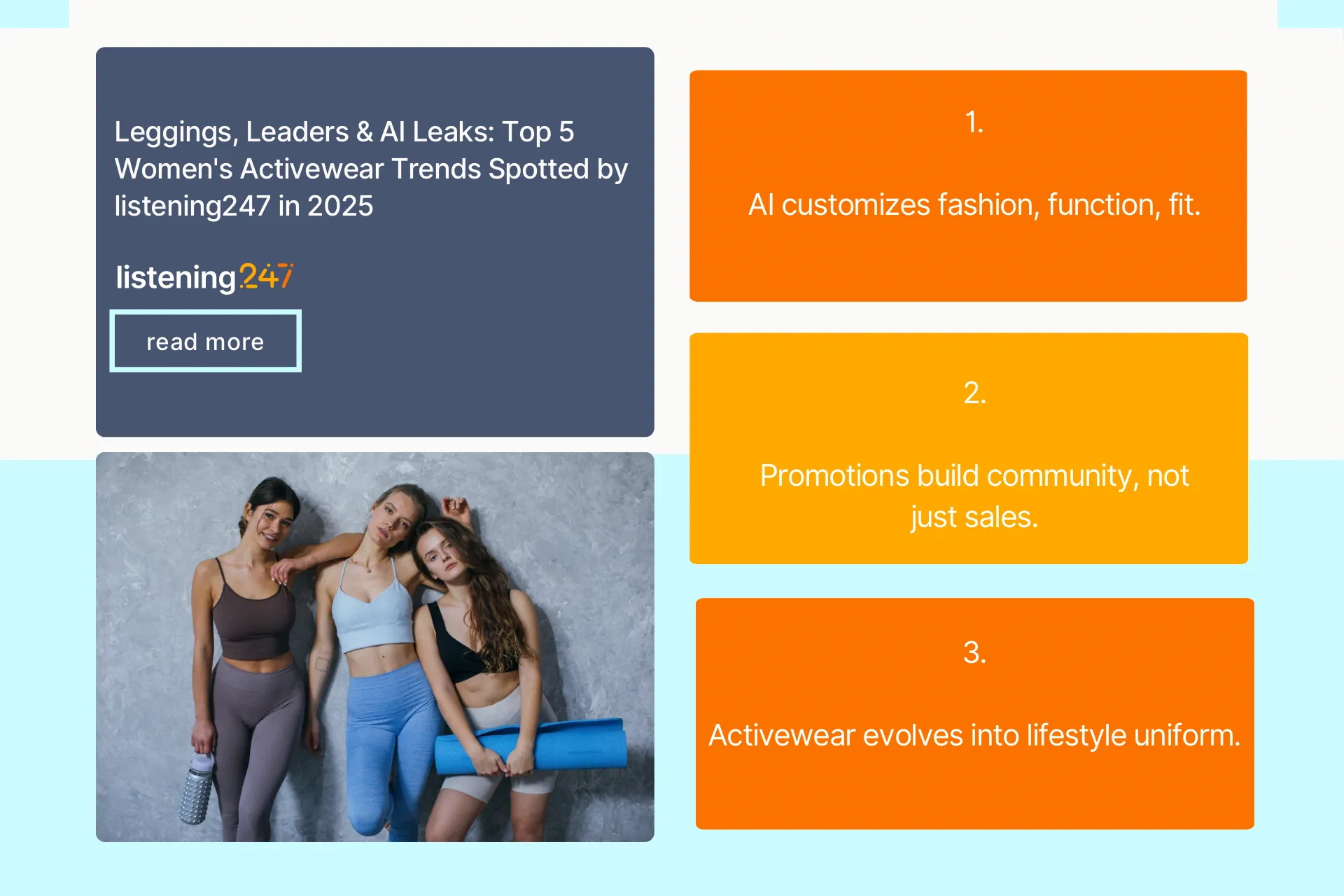
listening247’s analysis of 52,197+ conversations across Instagram, X, TikTok, YouTube, blogs, and forums reveals that in 2025, the women’s activewear industry is driven by five key topics:
Sports leads the discussion, reflecting the rise in women’s participation and their demand for performance-ready apparel, leading the way for brands to use AI to transform the industry with personalized user designs, smarter shopping, and data led marketing?
With the industry as a whole booming, consumers are embracing innovation, inclusivity, and the fusion of fashion and function; yet the presence of neutral sentiment signals an opportunity for brands to deepen engagement and build loyalty. The message is clear: consumers are invested, and the brands that stay ahead will be those that deliver comfort, tech, and meaningful connection.
The women’s activewear market is booming, set to skyrocket from $20.6B to $145.6B by 2032, driven by a surge in female participation in sports, growing health consciousness, and the rise of activewear as a lifestyle choice among millennials and Gen Z. Today’s consumers seek comfort, flexibility, and style tailored to their specific activities whether it’s running, yoga, or team sports; and brands are responding with tech-driven innovation.
AI is revolutionizing the game, enabling custom-fit designs through 3D body scanning, predictive movement analysis, and trend forecasting powered by machine learning. From adaptive fabrics to AI-generated collections, activewear is no longer just about function but rather it’s smart, stylish, and deeply personal.
Sources: (Fortune Business Insights) ; (The Brainy Insights) ; (TD Sportswear)
Activewear has evolved from a fashion trend into a full-blown lifestyle, with women leading the charge in blending comfort, style, and functionality into their everyday wardrobes. From the U.S. to China and Germany, global demand is being shaped by wellness, sustainability, and a desire for clothing that feels as good as it looks. Luxury fashion is also embracing the shift, with brands like Fendi and Versace launching athleisure lines.
Meanwhile, AI is accelerating this fusion of fashion and function by spotting trends before they go mainstream, enabling hyper-personalized shopping, and even co-designed collections mixing traditional sportswear and luxury. In 2025, activewear isn’t just what women wear to work out but it’s what they live in.
Sources: (Mintel) ; (Heuritech)
Customer experience is now as vital as the clothing itself. Brands build loyalty by blending technology, personalisation, and emotional connection, offering innovations like AI-driven recommendations, virtual try-ons, and community-driven insights. Consumers expect seamless, tailored journeys where trust, quality, and authenticity are paramount.
Consequently, the "best fit" is increasingly digital and emotional, not just physical. Leading sportswear brands, such as Nike and Lululemon, demonstrate this by harnessing AI and machine learning to deliver product suggestions and apparel explicitly tailored to individual preferences and precise fit.
Sources: (StoryStream) ; (Retail Technology Innovation Hub)
Lifestyle is the real trendsetter. Women aren’t just buying sportswear for workouts. They’re choosing pieces that reflect who they are and how they live. The demand for versatile, stylish, and comfortable clothing has blurred the lines between gym gear and everyday fashion, fueling the rise of luxury athleisure.
Whether it’s leggings at brunch or hoodies on a shopping run, activewear is now a uniform for modern, wellness-driven living. Brands are also responding to the need for eco-friendly materials by using technology to engineer sustainable materials that are durable, lightweight, yet soft and breathable.
As one of the fastest-growing segments in fashion, women’s activewear thrives on smart, high-impact promotions. Brands must go beyond basic ads by leveraging social media challenges, influencer partnerships, referral programs, and user-generated content to build awareness and loyalty. Campaigns like 30-day workout challenges or fitness-themed giveaways not only engage communities but also turn customers into brand ambassadors.
AI and machine learning are taking this further, enabling targeted ads that resonate with a consumer’s specific fitness goals and lifestyles. In this space, the best promotions aren’t just selling clothes. They’re fueling motivation, community, and connection.
Sources: (Photoshelter) ; (Opensend) ; (Digital Defynd)
Through listening247’s analysis of over 52,000 online conversations, it’s clear that the women's activewear market is thriving as it evolves from pure sportswear into a wellness lifestyle uniform. Future success is defined by the integration of AI and technology, which enables brands to deliver hyper-personalized products, compelling community experiences, and customer journeys where the "best fit" is emotional, digital, and physical.

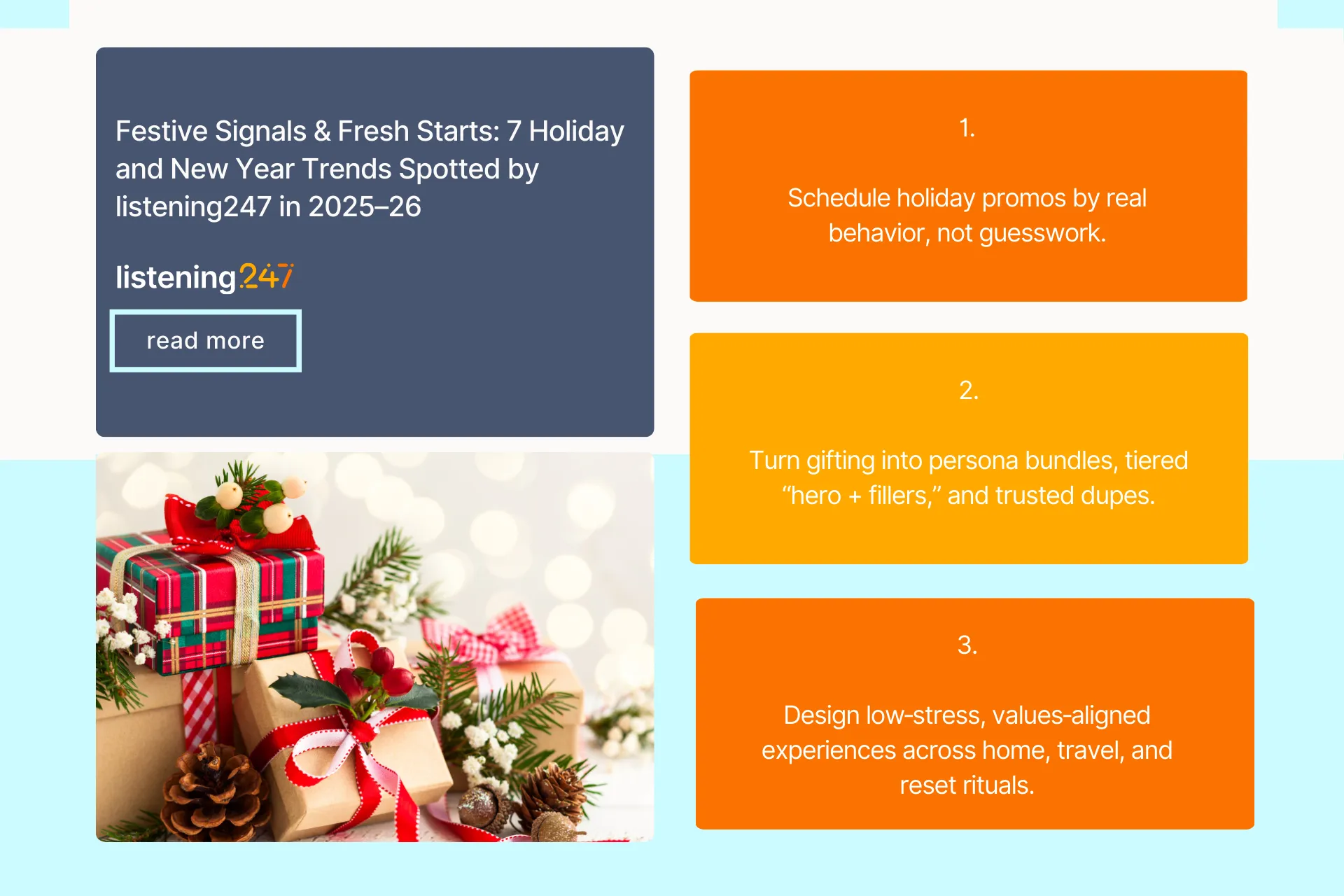
In peak season, the best gift isn’t always wrapped, it’s discovered through data. From nostalgia-driven gifting to AI-shaped shopping journeys, these are the seven holiday trends guiding how UK, EU, and US consumers plan, purchase, celebrate, and reset for the year ahead.
listening247’s analysis of 58,000+ public posts and conversations across X, Instagram, TikTok, Reddit, forums, and blogs, from the 2024 holiday season through today, reveals that the 2025–26 holiday season is dominated by seven themes:
Across the UK, EU, and US, positive sentiment toward the upcoming holiday season and brand-led experiences is strong, but a large neutral band signals opportunity. Brands that personalize, reduce friction, and clearly align their values with consumers’ priorities, from affordability and convenience to inclusivity and sustainability, will win both baskets and long-term loyalty.
Strategic takeaway: It is no longer enough to target broad segments; the advantage lies in targeting specific moments and mindsets across the season. Precision insight powers precision activation.
Shoppers are using AI gift finders (for example, tools like DreamGift or Genie by GiftList that recommend gifts based on a few questions), creator-curated guides, retailer wishlists, and social searches to match taste with budget.
“Dupes” (lower-priced alternatives that resemble premium or viral products, often discovered via social platforms and marketplace apps) are normalized, but quality signals such as reviews, user-generated content (UGC), and creator testing still drive purchase confidence.
Tiered gifting emerges as a key trend of the season, especially across UK and EU audiences but visible in the US as well. Shoppers are building gift “stacks” that combine one signature hero item with smaller add-ons such as practical stocking fillers, experiences (for example, tickets or vouchers), and small keepsakes.
What to do: Embed UGC and creator content into on-site recommendation widgets, such as “You might also like” or “Still deciding?” carousels on product and cart pages. Launch dynamic persona bundles such as gamer, home chef, skincare minimalist, or teen tech. Offer price-protected “gift match” guarantees to build trust.
Sources: Retail Technology Innovation Hub, StoryStream
Holiday shopping behavior concentrates at three points throughout the year:
US audiences lead Cyber sales while UK and EU see last-week click-and-collect surges.
What to do: Sequence communications by intent. Educate buyers in October and November through guides and comparisons while using Cyber week to convert into sales with transparent pricing and protection, and push convenience in late December with stock visibility, pickup options, and e-gift cards.
Sources: Photoshelter
Consumers prefer shareable, simple, and cozy experiences such as potluck dinners, themed movie nights, neighborhood light walks, small concerts, and workshops led by creators and influencers. Here “creator” can mean both social-first influencers and hands-on hosts (for example, a cooking class, crafting session, or mixology night). Social content rewards realistic, low-stress celebrations over polished perfection.
What to do: Package “event in a box” kits with playlists, décor bundles, local maps, and creator co-host nights. Provide downloadable checklists and templates for easy sharing.
Sources: listening247 social listening across TikTok, Instagram, and Reddit; creator economy analysis
Holiday food conversations center on easy prep, allergen-based food options such as gluten-free and dairy-free recipes while also staying budget-friendly. EU audiences emphasize local seasonal produce while US consumers over-index on shoppable recipe carts.
What to do: Pair recipes on your site or app with pre-built online shopping carts from your retail partners (for example, “add all ingredients to basket” with one click). Add “swap this for that” filters within the recipe or cart experience for allergen-friendly, budget, or dietary alternatives, and promote leftover ideas and storage tips to reduce waste.
Sources: Social video analysis and retail innovation coverage
Travel conversations highlight the need for flexible booking, transparent fees, and clarity on whether insurance options are worth it. Many travellers describe insurance as “worth it” for missed connections, medical issues, or disruption refunds. “Homecoming” storytelling, from small-town charm to family reunion content, performs strongly across all regions. European users specifically seek real-time transport updates amid local disruptions.
What to do: Promote flexibility upfront, provide live status updates, and curate close-to-home itineraries with local creators.
Sources: Reddit and forum analysis from listening247
Consumers are rejecting extreme resolutions in favor of small, steady habits such as 15-minute workouts, daily journaling, meal prepping, and sleep hygiene. UK and EU audiences embrace group challenges while US users lean toward app-based streak tracking and digital accountability.
What to do: Launch micro challenges with creator accountability bundles, starter kits, and develop adaptive, AI-personalized plans to track habits easily.
Sources: Behavior-change conversation analysis, Digital Defynd
Sustainability shows up as practical, not performative. Consumers embrace resale, rental occasion-wear, durable basics, and minimal packaging. Tone matters as well. It needs to be approachable and useful messaging to win consumer trust. EU discussions highlight circularity and resale, while the US maintains a focus on durability and long-term value.
What to do: Promote repair and resale programs, offer impact receipts, and provide packaging options or eco-delivery toggles.
Sources: Sustainability and fashion discourse, Vocast
Creators drive faster conversions with “I tested 5” or “what to actually buy” formats across Instagram and TikTok.
Social search is the new shopping assistant. Optimize captions and alt text for shopper queries such as “gift for dad under £50” or “last minute Secret Santa EU.”
Sentiment drivers include stock transparency, clear shipping cutoffs, authentic lifestyle content, inclusive representation, and smooth returns.
Friction points include hidden fees, late deliveries, unclear allergens, and inconsistent pricing between ad and cart.
This season isn’t about bigger lists but about smarter choices, simpler hosting, and more meaningful moments. With over 58,000 UK, EU, and US conversations analyzed across the last year, one truth stands out: when you know your audience deeply, targeting becomes effortless and performance follows.

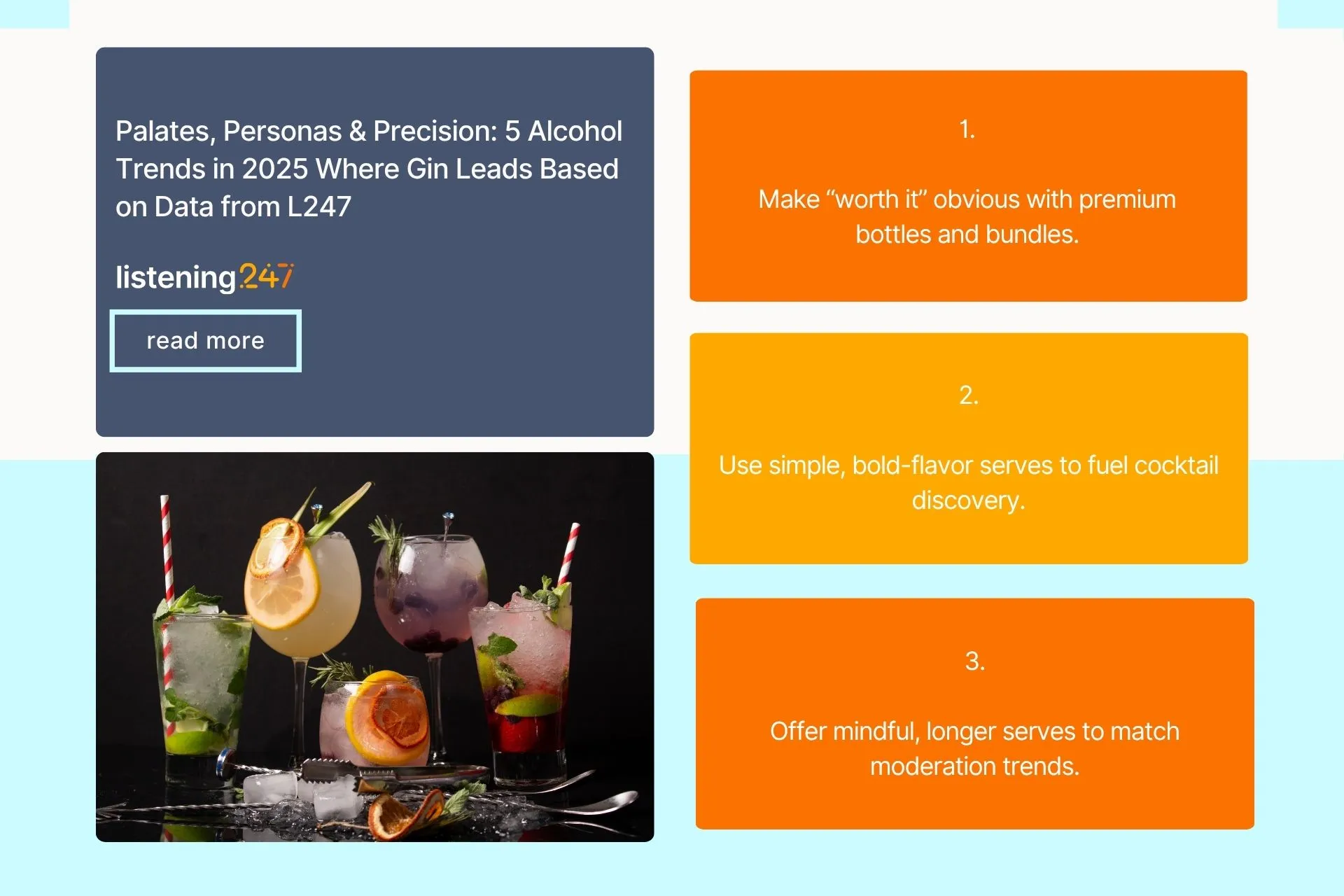
In alcohol, taste drives sales, but knowing your customer drives growth.
From premium rituals to mindful moderations, as dove into the habits of Gin drinkers in the UK, EU, and US, all based on public conversations across X, Instagram, TikTok, Reddit, forums, and blogs over the last 6–12 months, we identified the top 5 consumer trends shaping the Gin industry.
listening247’s analysis highlighted five dominant topics that matter to consumers for precision targeting:
Gin is uniquely positioned across all five: a canvas for mixology, a gifting favorite, a mindful-friendly base, a craft storytelling vehicle, and a creator economy staple. The takeaway is simple: the better you know your customer, what they value, when they drink, and how they discover, the easier and cheaper it is to target them.
Consumers talk about “worth it” bottles, limited editions, and gifting bundles - all which make them feel special. Gin performs strongly where botanicals, packaging, and glassware create perceived value. Clear use-cases (hosting, gifting, collecting) correlate with higher willingness to pay.
Targeting takeaways:
Source: In 2025, high-end spirits and premium mineral waters saw continued growth as younger consumers sought out quality over quantity (Forbes, 2025).
TikTok hashtag stream: #GinGifting (unboxings, bottle+glassware bundles): TikTok #GinGifting
Short-form videos fuel cocktail discovery; forums and blogs validate this by providing techniques and tips. Gin benefits from “five-ingredient max” serves and botanical exploration with citrus, herbal, floral, and tea-infused profiles surfacing as distinct flavor personas.
Targeting takeaways:
Source: According to the Brands Report 2025, gin continues leading bar menus globally, with brands like Tanqueray and Bombay Sapphire dominating cocktail lists, driven by flavor innovation and botanical exploration (Drinks International, 2025).
Blog Example: “3 citrus-forward gin serves in under 20 seconds” (short-form compilation frequently shared to IG/TikTok): A Couple Cooks – Gin Cocktails Note: long-running page, updated frequently and widely reshared in Reels.
TikTok hashtag stream: #5IngredientCocktails (simple builds, high saves): TikTok #5IngredientCocktails
Low/no-alcohol and sessionable serves are mainstreaming. Consumers want to keep the ritual without the excess. Gin-alternative bases and long G&Ts/spritzes are popular in weekday and wellness-aligned moments.
Targeting takeaways:
Source: Nearly half of U.S. consumers planned to drink less in 2025, with Gen Z leading the moderation movement, boosting low/no RTD categories, especially in gin (Forbes, 2025).
Blog Example: “Best non-alcoholic gins and long-serve ideas” (shared widely on social): The Spruce Eats – Best Non-Alcoholic Gins
TikTok hashtag stream: #SoberCurious (alternation, low/no builds): TikTok #SoberCurious
Sustainability discussions are rewarded when details are provided such as where the botanicals are sourced, regenerative practices, water/energy footprints, lightweight packaging, and refill options. Provenance storytelling, the act of communicating a product's or brand's history, origin, and journey as a compelling narrative, performs best when paired with verifiable progress.
Targeting takeaways:
Source: Provenance storytelling is central to the premiumization of gin, with brands emphasising botanicals sourced from distinct geographies and eco-friendly production (Drinks International, “Gin: Keeping It Real”).
Instagram hashtag stream: #SustainableGin (lighter glass, recycled content, energy/water claims): Instagram #SustainableGin
Promotions that educate outperform general discounts. QR-to-recipe journeys, flavor quizzes, creator-led tastings, and geo-targeted events move audiences from awareness to trial to repeat purchases.
Targeting takeaways:
Source: Consumer conversations on promotion-driven discovery highlight how education-first activations and storytelling outperform discounting (The Grocer, 2025).
TikTok hashtag stream: #CocktailQR (QR-to-recipe content flows): TikTok #CocktailQR
Instagram: #GinTastingEvents (geo-tagged tastings; UGC recaps): Instagram #GinTastingEvents
Alcohol’s growth in 2025 is shaped by consumers who want to be part of a story and simplicity. Gin is perfectly placed to win the moment: flavor forward, ritual ready, provenance proof, and creator friendly. With listening247’s AI, brands can turn noisy conversations into precise segments, so the right bottle, serve, and story meet the right person at the right time.

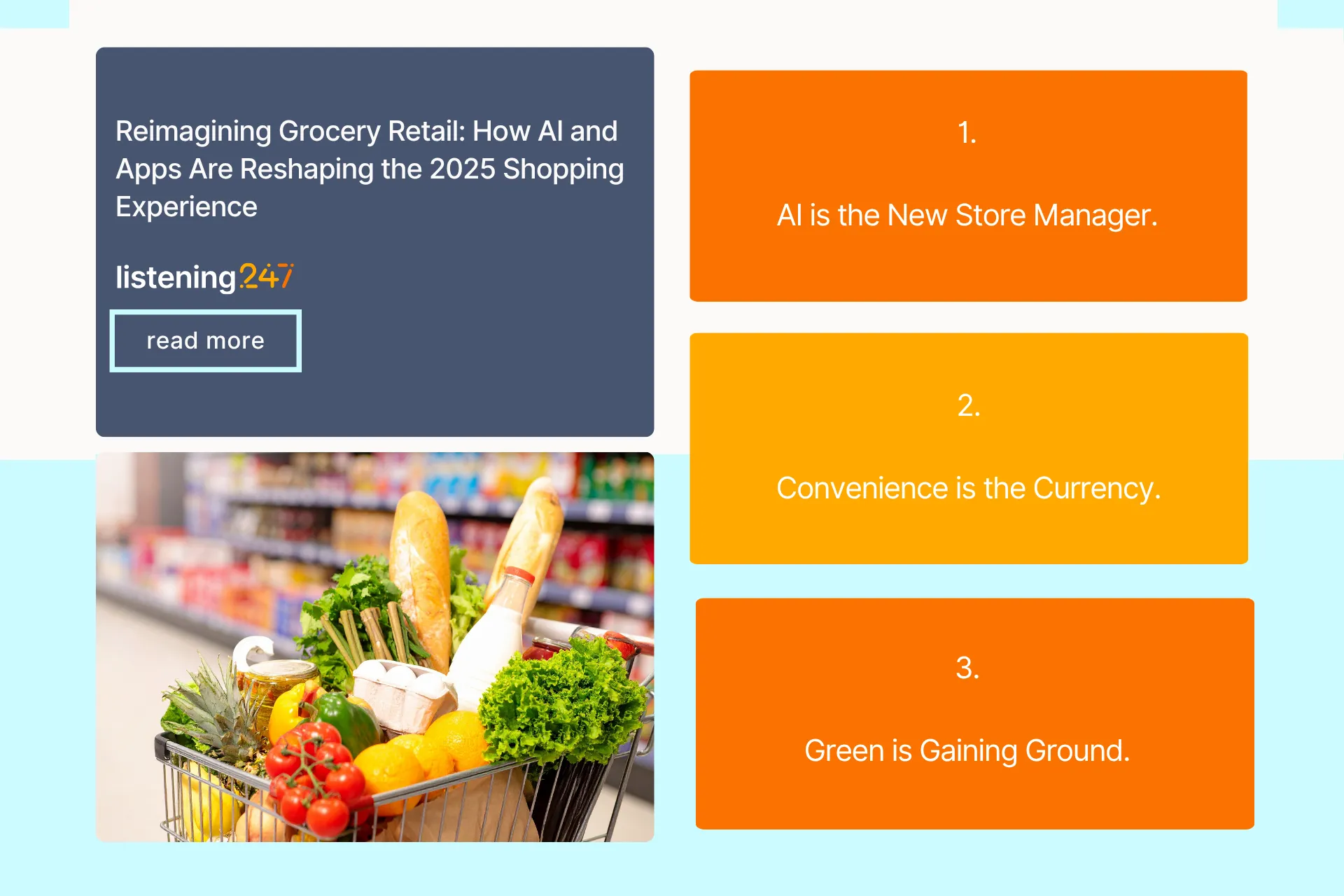
What do over 9,300 social media conversations on platforms like X, Instagram, and TikTok analysed by listening247 tell us about the grocery retail industry in 2025? It’s in the midst of transformation. Technology, sustainability, and evolving consumer habits are reshaping how we shop for groceries. This blog dives into the latest trends and how retailers are using AI and automation to meet the rising demand for convenience, personalisation, and seamless shopping.
Did you know? Online grocery shopping has jumped 56% since 2022, with 22% of consumers now using delivery or pickup services.
In 2025, convenience is king. Shoppers want quick, affordable, and easy ways to buy groceries online or offline. To keep up, grocery stores are turning to tech like AI and unified checkout systems to manage inventory and prevent stockouts, while delivery services via mobile apps allow for speed and convenience. This, in turn, gives grocery brands more data to personalise the online shopping experience.
Sources: (Drive Research)
More shoppers are thinking green. From reducing food waste to offering local and eco-friendly products, sustainability is a priority. Smart checkout systems help by adjusting prices to avoid waste and highlighting eco-products. In South Africa, 64% of consumers are willing to pay more for sustainable goods. This means retailers who make green options affordable and visible have a big opportunity to lead and win loyal customers who care about the planet.
Sources: (Extenda Retail); (KLA)
Many stores are turning to automation to lower costs and increase efficiency within their stores. Self-checkouts, mobile payment options, AI inventory tracking, and even cashierless stores make shopping faster and easier. Behind the scenes, these technologies also help reduce errors. Think smart shelves that track stock and AI to predict busy times so stores can staff smarter, or even autonomous stores that run almost by themselves. Automation is not just about convenience, it’s about efficiency.
Sources: (Extenda Retail); (Scale Computing)
Today’s shoppers are seeing shopping experiences tailored just for them. Using AI and data, grocery stores can create personalized deals, targeted ads, and in-store experiences that feel unique to each customer. Stores are using data collected to better identify their ideal customer profile and tailor stocked items or promotions for that group, turning data into meaningful connections. Personalization is no longer a bonus but expected by consumers.
Sources: (IGA); (Supermarket News)
.Shoppers want to move seamlessly between physical stores, websites, and apps. Retailers are building integrated systems powered by AI to deliver consistent, personalized experiences no matter where you shop. With 73% of consumers preferring multichannel shopping, stores that don’t connect their online and offline worlds risk losing customers. AI helps by analyzing data across all touchpoints, allowing real-time personalized service and smarter marketing. The challenge? Keeping data private and using AI ethically.
Sources: (Uniform Market); (Strategy Software); (Bridg)
AI is driving the changes behind these grocery retail shifts. It helps predict what customers want, manages stock efficiently, personalizes offers, and smooths out delivery logistics. In a world where budgets are tight and shopping habits shift fast, AI enables retailers to stay agile and relevant.
With over 1 in 5 shoppers now buying groceries online, AI makes sure the experience is seamless, cost-effective, and scalable, helping stores grow while meeting new consumer expectations.
By listening247 analysing over 9,300 social media conversations around grocery shopping trends, it’s clear that the 2025 grocery retail industry is defined by five big forces: online shopping, sustainability, automation, personalization, and omnichannel experiences. Consumers want more than products, they want convenience, value, and choices that reflect their values. To win, retailers must become data-driven and customer-focused, using AI and technology not just to keep up, but to lead. The future of grocery shopping isn’t just about shelves and checkouts but it’s about smart, seamless, and sustainable experiences that connect with shoppers on a whole new level.

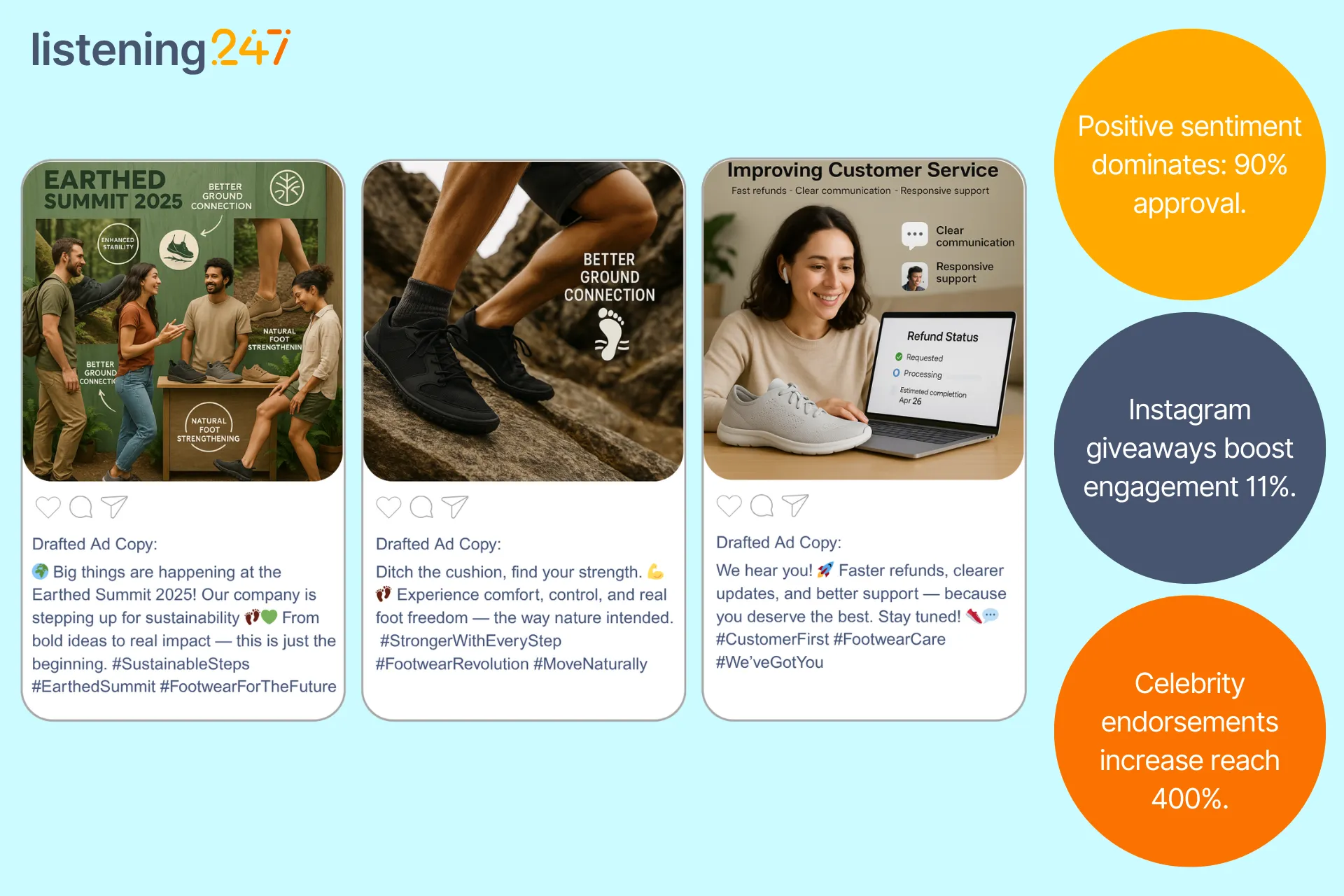
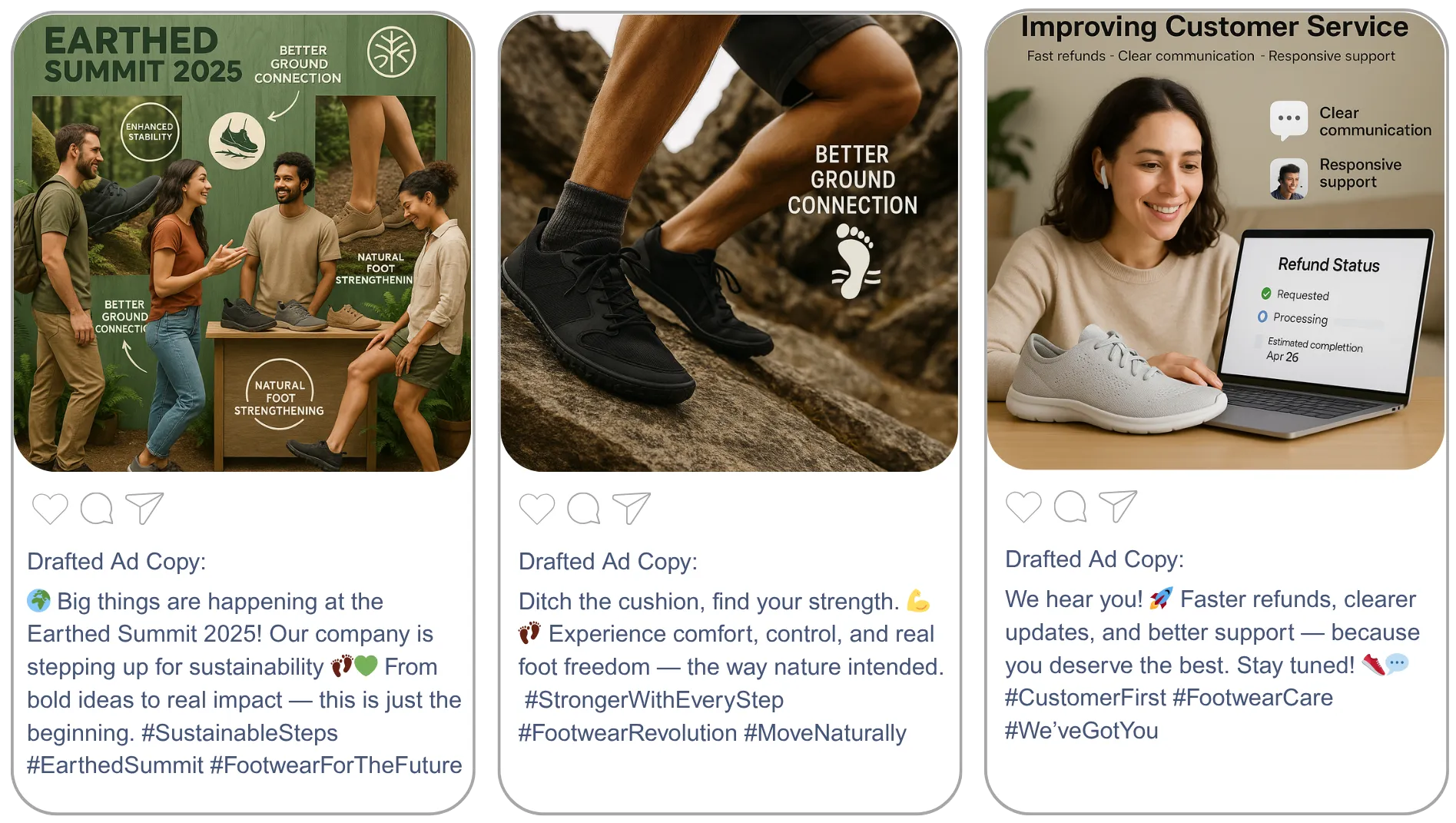
listening247 creates a monthly insights report of outdoor/sports footwear for a minimalist running shoe company to:
Using its proprietary Gen AI model, l247
Based on identified conversations, L247 used its proprietary Gen AI model to create copy an imagery for ads:

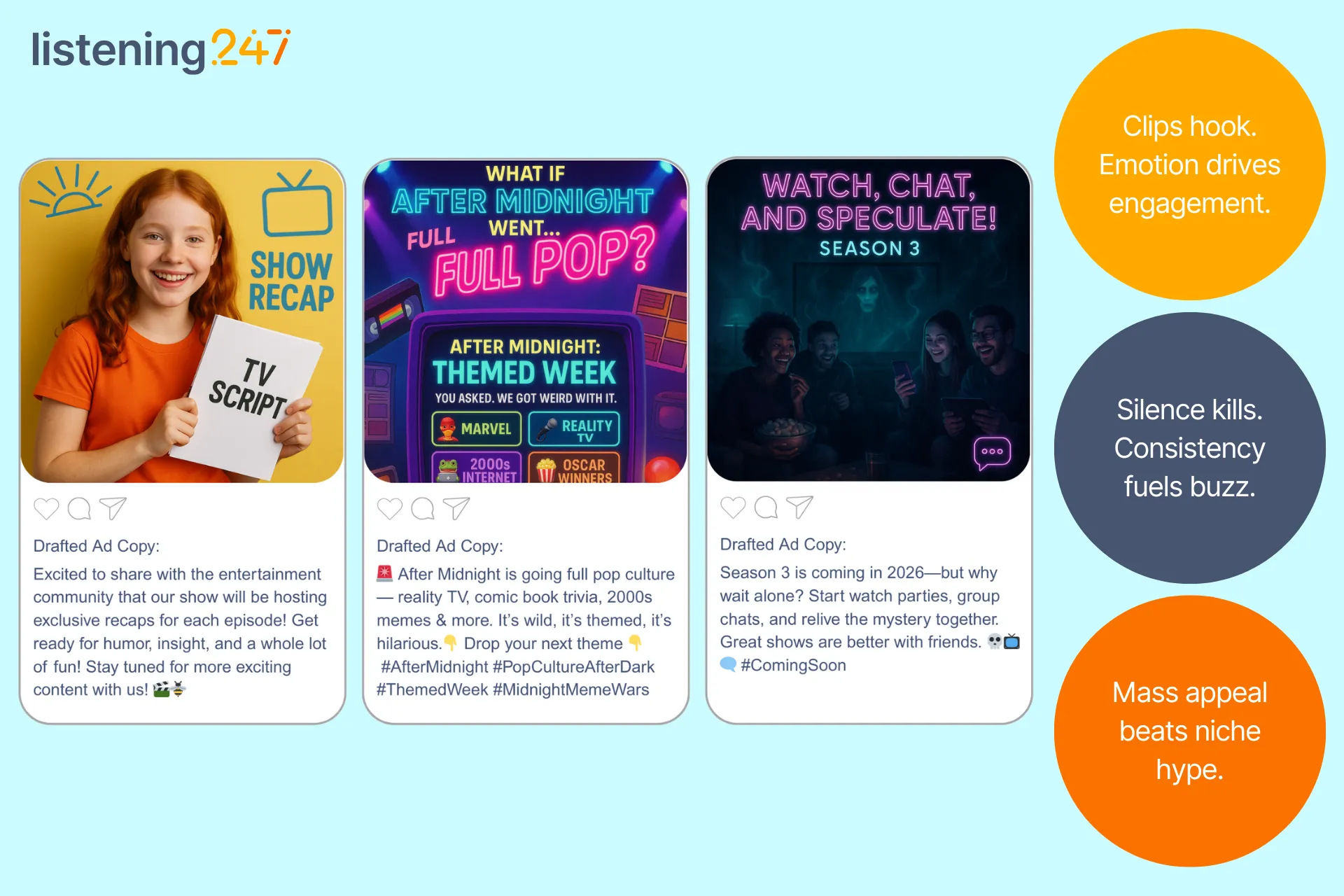
listening247, in partnership with Double A Labs and a top film production and distribution company about the “Why and How Social Media Influences Viewership or Brand Perception.” The objective was to:
Digital Focus Groups + Social Listening
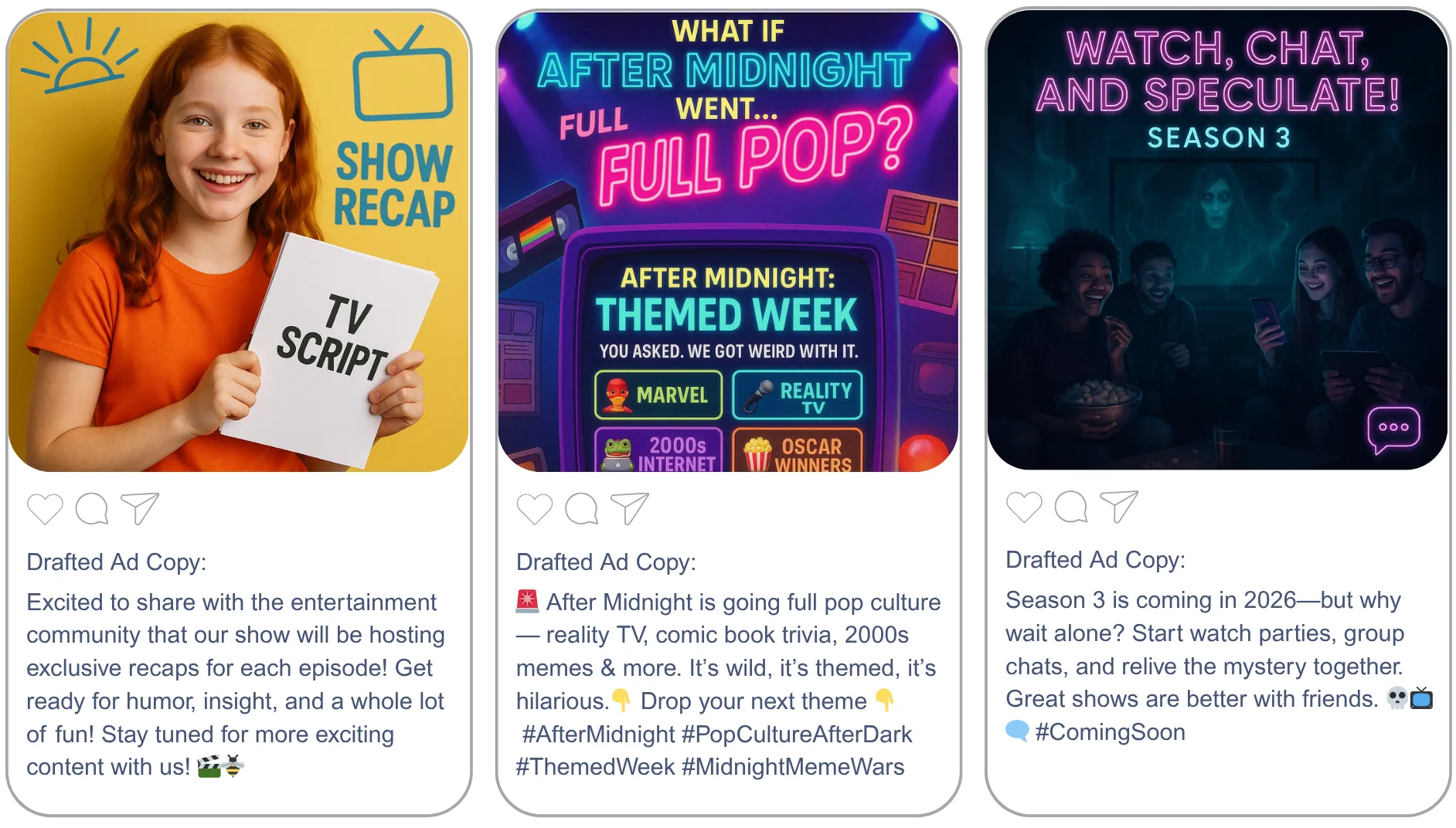

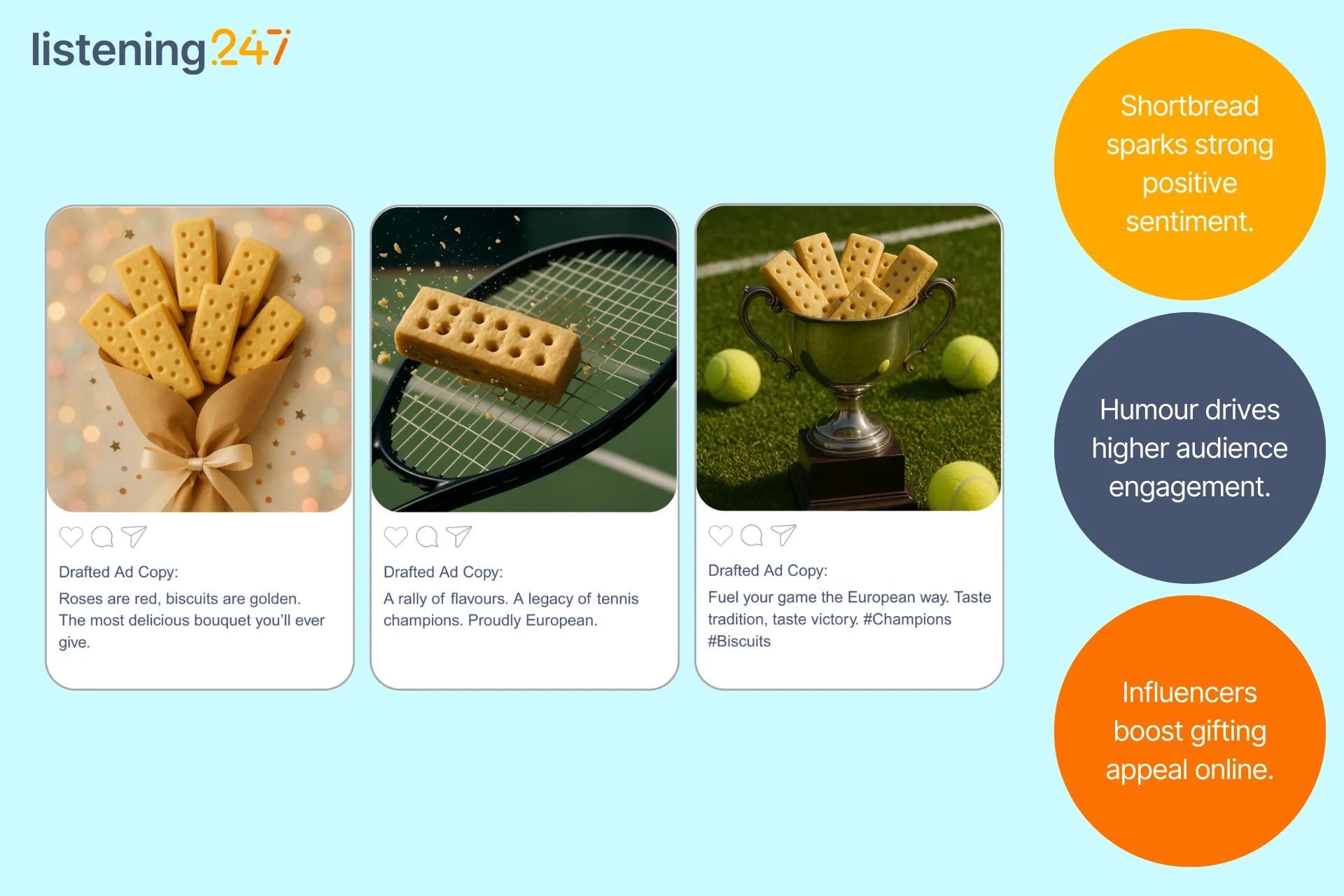
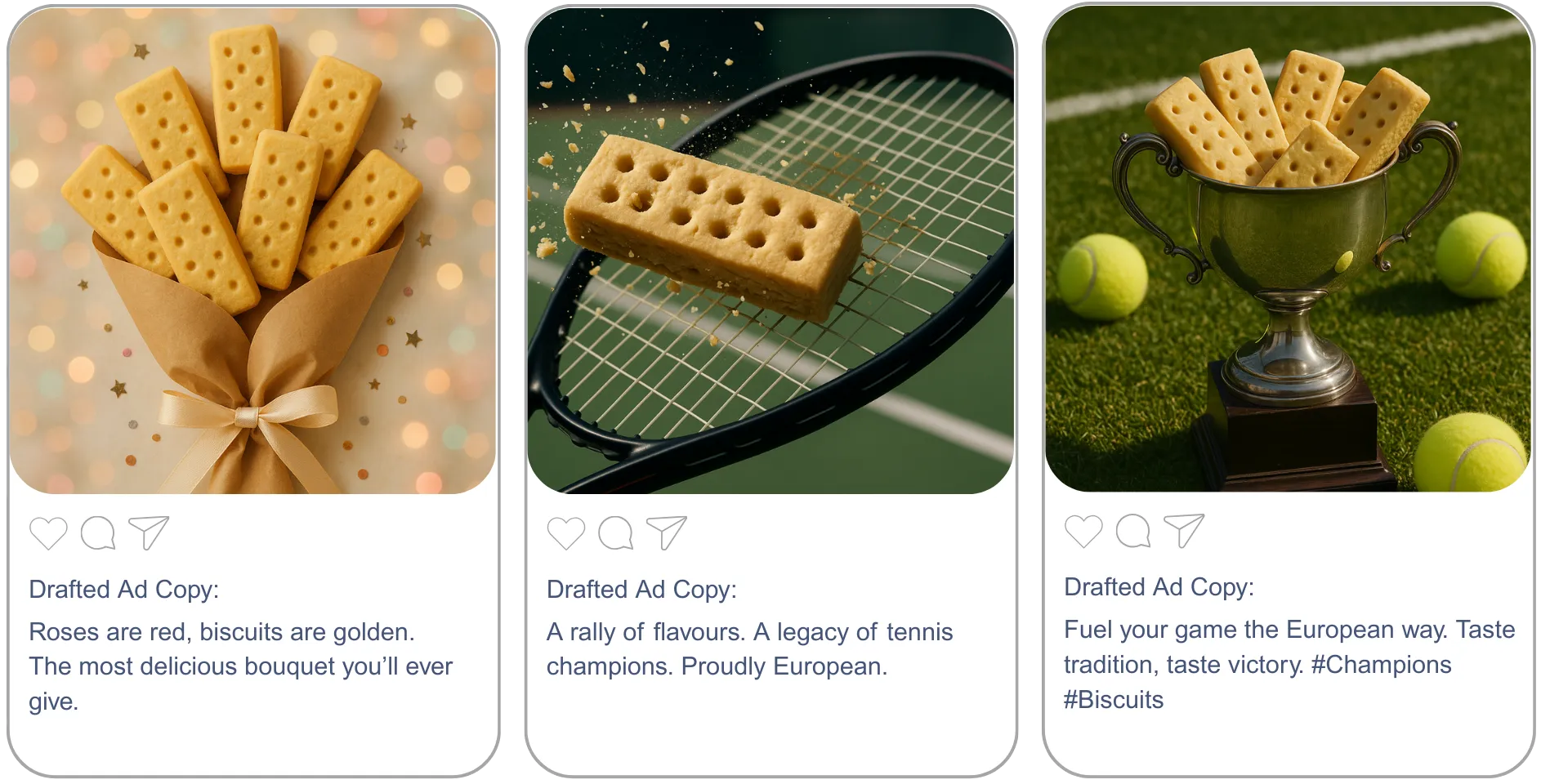
listening247 chose to analyse the consumer segment for biscuits to conduct analysis and create opportunity by understanding:
Using its proprietary Gen AI model, l247:

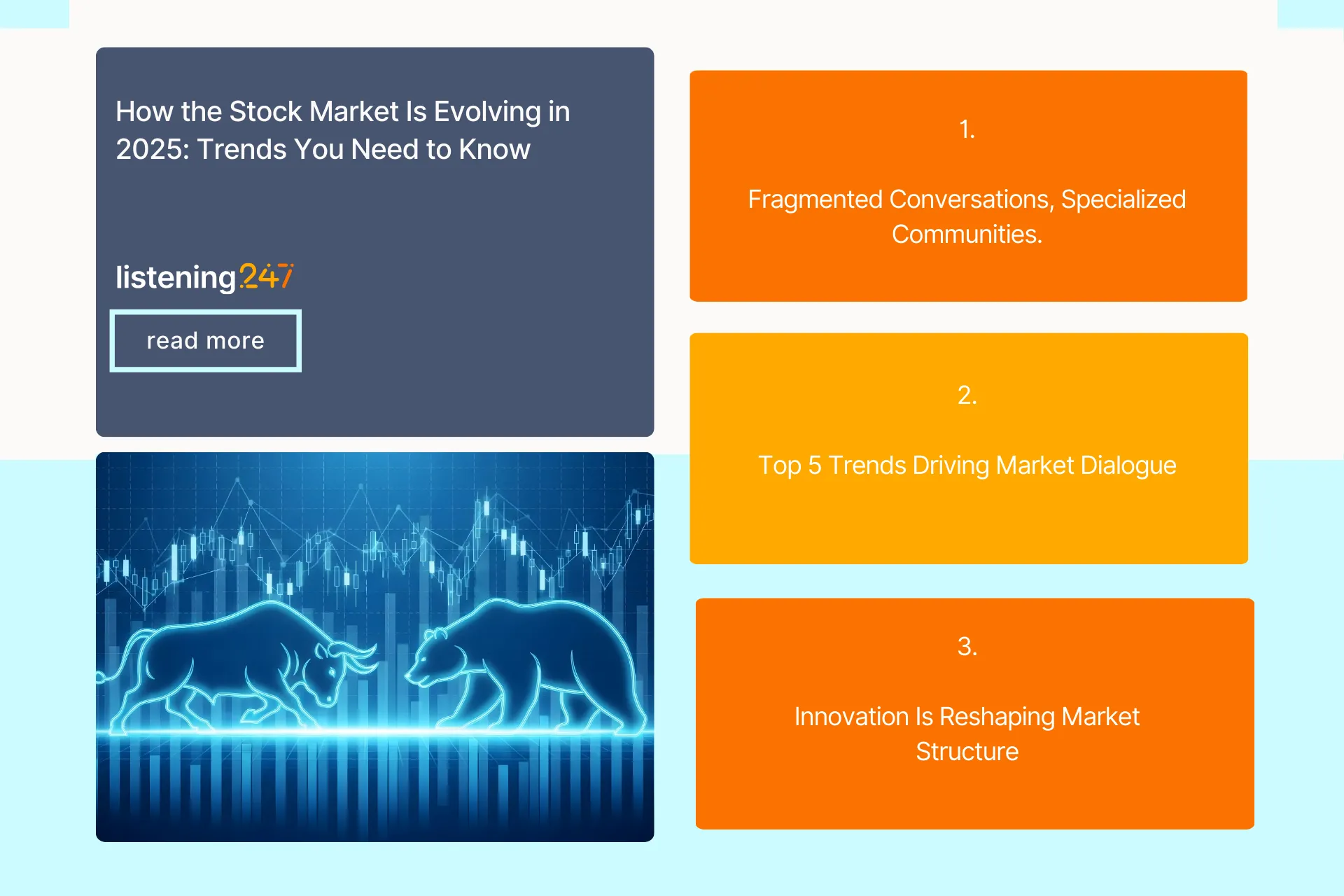
What do thousands of online conversations about the stock market reveal? The old way of doing things is gone. The market is no longer a single, unified place but a collection of specialized communities, each with its own interests. Company Fundamentals are no longer enough to discover alpha; alternative data (sentiment and buzz) from social media conversations are becoming an integral part of every hedge fund's investment strategy. To succeed, you have to know what matters to each one.
listening247 collected, processed, and analyzed over 200,000 social media conversations on X, Instagram, forums, and blogs and discovered the top (5) conversations leading the online discussions:
Surprisingly, Regulations and compliance (13,225 posts) and Technology and innovation (13,099 posts) were further down the list than expected.
Why is this valuable? The data reflects a growing fragmentation of the market's social dialogue which suggests distinct communities, each with its own set of concerns and interests. The stock exchange is evolving into a collection of interconnected but specialized markets, each with its own dedicated audience that should be monitored to ensure each niche is being recognized to ensure growth.
People are talking about new ways to invest as the securities exchange market is poised to grow by $56.67 billion by 2029. Things like digital assets and sustainable investments such as ESGs, are becoming a big deal. It's not just about getting a good return; it's about making a positive impact. But with innovation comes new risks. Market volatility is rising, pushing gold prices up and making debt more fragile.
Sources: (SA Reserve Bank); (technavio.com); (easyequities.co.za)
The trading market is faster and more accessible than ever. Automated trading and smart algorithms have made it easier for everyday investors to get involved. Growth stocks, small-caps, and ETFs are in the spotlight as investors look for strong returns. But being fast isn't enough. The key to success is having a long-term strategy and a diverse portfolio.
Sources: (Trading Bells); (The Recursive); (itbfx.com)
Listing a company on an exchange is no longer a local affair. With 62% of U.S. stock exchange listings now originating from foreign issuers, this shows the market is interested in deep liquidity and investor access through the NYSE. Geography now matters less than the value proposition an exchange offers.
New private markets, like London’s Pisces and Kenya’s micro-share trading, are also emerging, offering more ways for companies to raise money and a wider variety of options for investors.
Sources: (ey.com); (monkeyweek.com); (jse.co.za); (linklaters.com)
As everything moves online, a new community focused on security is growing and needed. Threats from hackers and sophisticated cybercriminals are on the rise exploiting weaknesses to advance geopolitical goals and challenge the security of stock exchanges.
This has led to an increased demand for stricter regulations, software security measures, and educating of consumers to better defend and keep financial systems safe.
Sources: (mofo.com) (jpmorgan.com)
Crypto is no longer on the outside looking in. Things like tokenized stocks offered by Kraken, have blurred the lines between crypto and traditional investing, making it possible to trade assets like Apple and Tesla 24/7 across borders. This enables a level of global participation and liquidity that legacy exchanges were never designed to handle leading to regulators, such as the SEC and CFTC, racing to build the scaffolding and infrastructure to blend the agility of crypto with the stability of traditional finance.
Sources: (reuteurs.com); (reuters.com); (forbes.com); (financeworld.io)
While the above five topics dominate the conversation, two other trends are quietly driving big changes. AI technology is now a core part of the market, helping to spot fraud and create personalized investment plans.
Looking ahead, AI will likely reshape the very architecture of stock exchanges. Expect to see AI-regulated trading platforms, smarter market surveillance systems to detect fraud and manipulation, and more personalized investment strategies driven by AI-powered robo-advisors. Exchanges may adopt AI to improve settlement efficiency, reduce systemic risk, and automate compliance. However, as AI grows more influential, regulators will face a tough balancing act: ensuring transparency, accountability, and fairness in a world where machines might understand the market better than we do.
The stock market of 2025 is a mix of traditional finance and new ideas, each with their own distinct communities and needs for continued growth and expansion. By reviewing over 200,000 posts, we see the market being reshaped by digital assets, faster trading, and a surge in cross-border listings. This evolving landscape blends traditional finance with innovation and global connectivity, while creating new opportunities and challenges for investors and regulators alike.
To succeed in this new landscape, it's essential to not only understand the broad trends but also actively listen to and engage with the unique concerns of each specific community, transforming challenges into opportunities.

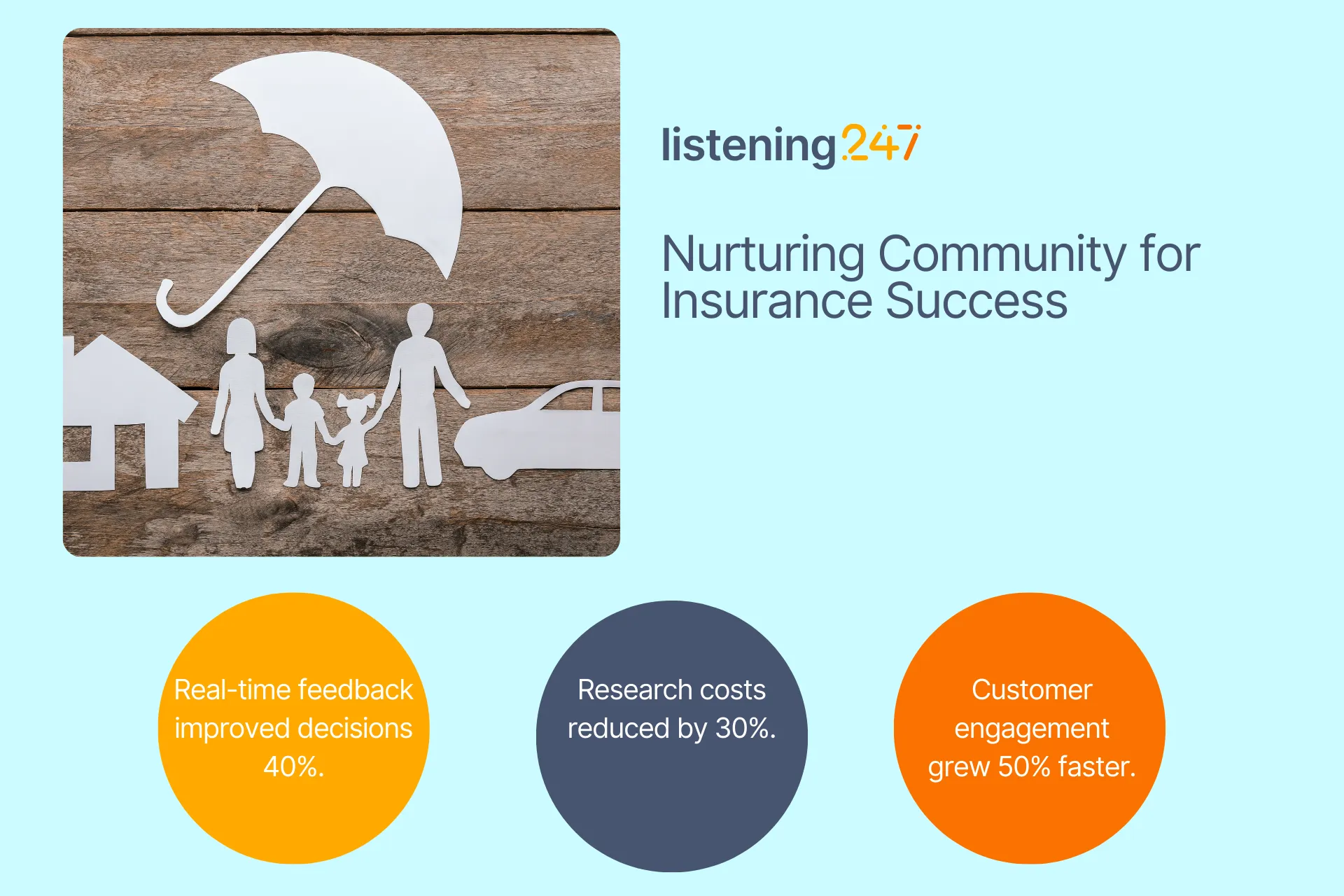
Facing rising costs and shifting consumer needs, an insurance leader turned to a private online community to unlock real-time insights and drive smarter growth.
A leading insurance company was faced with the challenge of creating educational material that addressed the concerns, whilst guiding the right consumers towards selecting the right type of insurance. The company needed a solution that was both quick and cost-effective to discover insights about the insurance industry and achieve effective communication with customers.
To address these challenges, listening247 introduced an innovative solution: a private online community platform designed for the insurance company to gain a better understanding of customer perspective when it comes to its products and services. This platform facilitated real-time interactions and allowed the company’s necessary departments such as the marketing and research team to conduct various activities such as bulletin board discussions, surveys within the community and video diaries.
1. Efficient Decision-Making: The customer quickly gathered initial input from consumers, which guided crucial marketing choices, ensuring they maintained a competitive edge in the market.
2. Enhancement of Economic Strategy: The online community platform minimised total market research expenses by delivering valuable insights, thereby optimizing the return on investment for marketing expenditure.
3. Enhanced Consumer Engagement: Consistent interaction with the consumer base via the platform bolstered brand loyalty and offered more profound insights into the consumer experience, leading to enhancements in marketing strategies and product offerings.

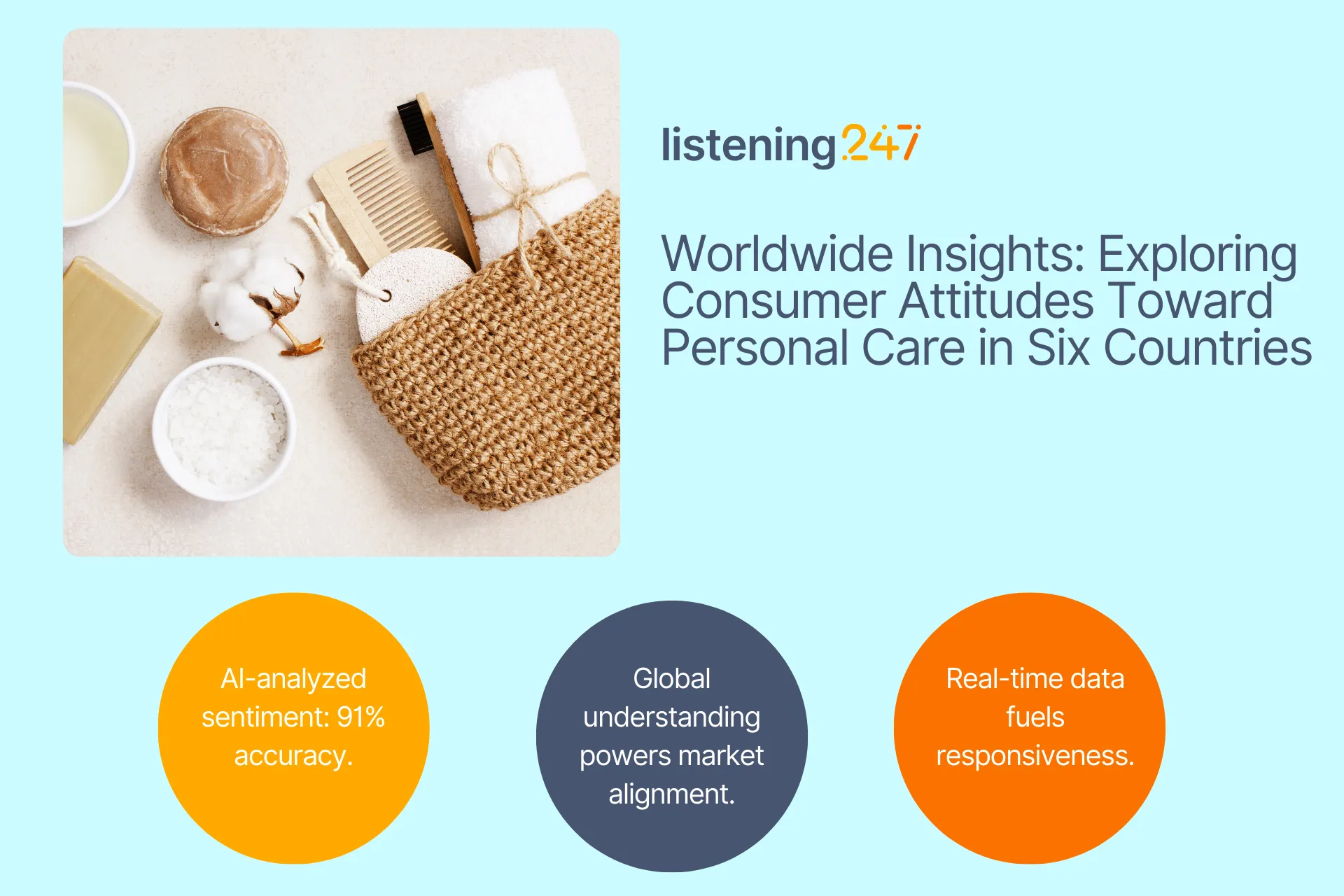
To stay ahead in the competitive personal care market, a global blue-chip organisation sought to deeply understand consumer perceptions across six diverse countries. Facing the challenge of capturing nuanced attitudes in multiple languages, they partnered with listening247™. Leveraging advanced AI-driven social intelligence, the initiative uncovered real-time, high-accuracy insights that informed strategy, enhanced campaign effectiveness, and aligned offerings more closely with consumer expectations.
A global blue chip organisation need to explore the landscape around a personal care category in 6 different countries to discover consumer perception and attitude towards their product. They goal was to thoroughly investigate consumer perceptions and attitudes around the personal care category to better inform future marketing campaigns.
To tackle these obstacles, listening247 adopted an all-encompassing social intelligence strategy employing sophisticated AI models. This method entailed gathering data from various digital platforms that covered user posts on public websites in 6 different languages including German where the sentiment accuracy at sentence level was 91%. The data was then carefully harvested, followed by the process of noise elimination to remove irrelevant posts. This data underwent meticulous annotation, detailing information on brands sentiments and topics.
1. Dynamic Market Reactivity: Utilising the listening247™ platform enabled the client to monitor shifts and adjust promptly, thereby sustaining a competitive advantage.
2. Enhanced Marketing Strategy: The results were leveraged by the client's advertising agency to craft upcoming campaigns.
3. Better Market Alignment: The provided insights enabled the client to synchronise their offerings with consumer preferences, thus improving customer engagement.

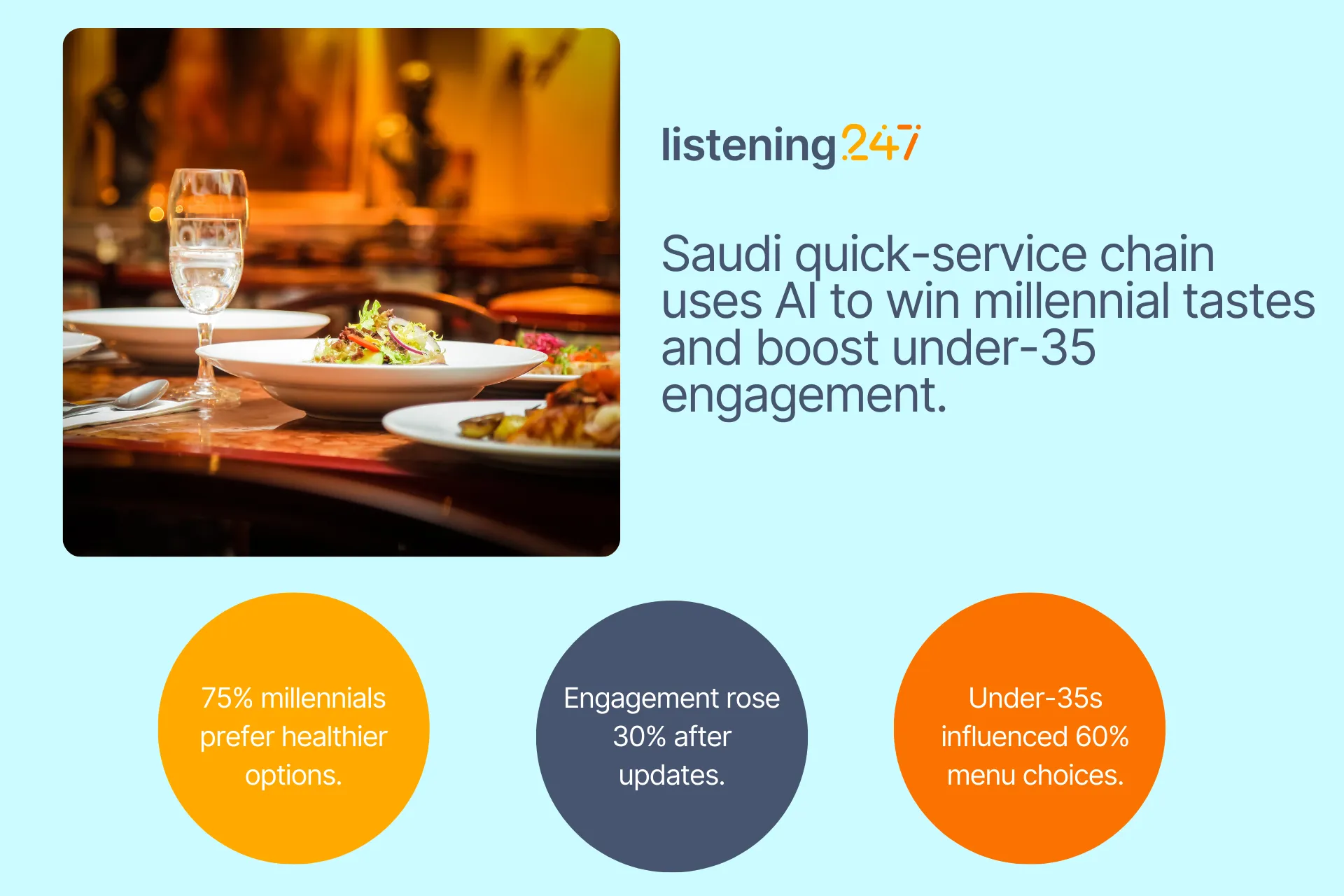
A leading Saudi quick-service chain faced the challenge of decoding under-35 consumer trends from vast multilingual data. Using advanced AI and three months of digital insights, listening247 helped tailor menus that boosted relevance, engagement, and informed decisions.
A leading quick service restaurant chain in Saudi Arabia needed to grasp the consumer trends among the under-35 demographic. The challenge was to sift through extensive multilingual digital content from various platforms to extract precise, relevant data.
To address these challenges, listening247 implemented a robust methodology involving the collection of three months' worth of historical data across key digital platforms, using generic keywords to capture a broad spectrum of consumer behaviour and preferences. Advanced AI models were employed to annotate the data with sentiment and relevant topics.
1. Informed Decision-Making: The insights allowed for data-driven adjustments to the restaurant's menu.
2. Enhanced Market Relevance: Understanding young consumers' preferences enabled the restaurant to better align its offerings.
3. Improved Customer Engagement: The strategic updates led to higher engagement and satisfaction from the crucial under-35 market.

With Valentine’s Day on the horizon, the chocolate industry is in full swing to make their mark and drive sales and brand engagement. Using listening247’s Social Listening and Analytics, we analysed 24,930 posts from Instagram across multiple regions and languages, including English, Italian, Korean, and Indonesian. Our goal? To uncover the most influential conversation drivers around chocolate, love, and seasonal promotions.
Among the posts analysed:
If there’s one thing chocolate lovers adore more than indulging, it’s winning free chocolate. Giveaway promotions dominated the conversation, accounting for 14,884 of the total posts analysed. Brands like That’s It and Choczero sparked engagement through interactive contests, encouraging users to tag, share, and follow for a chance to win exclusive treats. Lindt and Baci Perugina took things further, tying their giveaways to limited-edition Valentine’s chocolates, ensuring their brand stayed top-of-mind as shoppers browsed for the perfect gift.
Takeaway: Giveaways don’t just create buzz; they build brand affinity and amplify visibility across social media. Tying contests to seasonal events maximises impact.
Valentine’s Day isn’t the only reason people talk about chocolate; seasonal occasions accounted for 6,085 posts, reinforcing how deeply chocolate is woven into celebrations. Brands like Lindt and Baci Perugina successfully capitalised on holiday excitement with heart-shaped boxes, themed promotions, and limited-edition releases.
Beyond promotions, people are passionate about their chocolate preferences. 3,801 posts discussed chocolate types, from dark and milk varieties to unique flavours. Discussions on discontinued favourites like mango and cream truffles gained traction, highlighting opportunities for brands to reintroduce nostalgic flavours.
Takeaway: Nostalgia sells. Revisiting past favourites or launching limited-edition throwback collections can rekindle consumer excitement.
Valentine’s Day-specific promotions accounted for 807 posts, with Lindt’s Pick & Mix selections and Baci’s signature love-note chocolates standing out. While consumers embraced these festive offerings, some concerns emerged around pricing. A Valentine’s loyalty programme could be a strategic move to balance premium appeal with affordability.
Takeaway: Limited editions fuel demand, but pricing strategies should ensure accessibility without compromising brand value.
With 493 posts, chocolate emerged as more than just a treat; it’s a symbol of affection. Baci Perugina’s multilingual “Love Note” campaign was a standout, adding a personal touch that deepened emotional connections. Lindt’s Pink Mixed Bar Bouquet and Lindor chocolates, often paired with roses, reinforced the role of chocolate in heartfelt gifting.
Takeaway: Thoughtful packaging and personalised messaging enhance emotional appeal and gift desirability.
Although less frequently mentioned, events and gifting traditions made their mark, with 275 posts discussing chocolate’s role in group celebrations and gifting culture. The Valentine’s Chocolate and Wine Walk was a particular highlight, proving that immersive brand experiences leave a lasting impression.
Takeaway: Experiential marketing, such as chocolate pairing events, can deepen consumer engagement beyond traditional advertising.
Valentine’s Day remains a key moment for chocolate brands.The top-performing strategies? Giveaways for engagement, personalised packaging for emotional appeal, and nostalgia-driven product revival to spark consumer excitement. Brands like That’s It, Lindt, and Baci Perugina demonstrated how interactive campaigns and thoughtful promotions can turn seasonal shoppers into lifelong customers.
As brands prepare for the next big occasion, one thing is clear: chocolate is more than just a treat; it’s a storytelling tool, a memory-maker, and the ultimate symbol of indulgence and love.
As one would expect, social media intelligence (or just social intelligence) came up as a subject at the “Social Intelligence World” conference in London back in November 2018. More specifically, it came up in the context: how does it differ from social media listening?
This question took me back several years, when we published our first eBook about “web listening”, our label of choice at the time which was a buzzword; its most popular version was “social media monitoring”. Social media intelligence did not come up at all back then, albeit in hindsight it is odd that it didn’t. I am not sure how we missed it then, but now, when someone asks what is the difference between intelligence and listening, the answer seems quite obvious!
Social media listening or social media monitoring is simply about harvesting the online posts and maybe even annotating them with a topic and/or sentiment. If the annotation is accurate then it answers questions like ‘what are people talking about online’ or ‘how do they feel about my brand’? Social intelligence on the other hand, is about understanding the deeper meaning of what people choose to post - although sometimes there isn’t one - and link it to a business question; notice how the term ‘actionable insights’ has not come up yet? Another buzzword that is overused in the market research sector, and another one for which we published numerous blog posts with our own - very concrete - definition of what it really is!
When we say ‘social media’ in this context we don’t just mean social media platforms, but rather any public online source of text and images which might express consumer or editorial opinions and/or facts. A side note: things would be a lot easier if we meant what we say in a literal way. People who coin phrases or titles or headings tend to take a lot of freedoms on the altar of “crispness” or “snappy creativity”!
listening247 - an aspiring state-of-the-art DIY SaaS looks at the world of social intelligence via four lenses:
We would be remiss if we didn’t mention text and image analytics as a standalone discipline when the source is not social media or other online sources. In such a case the only difference is that the source is not the online web but any other source of text and images. Perhaps if the source is not the online web it should just be called Business Intelligence, which is an old and very familiar discipline within organisations.
Back to the 4 modules, they have the power to generate intelligence derived from unstructured data - which make up 80-90% of the human knowledge, produced since the beginning of time. Structured data which are effectively numbers in tables or graphs only account for 10-20% of all our knowledge as a species.
Unstructured data can be harvested from the web and if we want to stay out of jail we will stick to public data (as opposed to private conversations or personal data). They can be harvested through APIs that the sites which contain the data make available for pay or for free, and through scrapers which can crawl a website and find specific consumer or editorial posts. Responses to open ended questions in surveys, transcripts of focus groups or even call centre conversations are also great sources of opinions and facts (i.e. unstructured data).
In order to make sense of big unstructured data, machine learning is a good place to start. Supervised machine learning requires humans to annotate a big enough sample of the available data. The annotated data-set is then used to train a machine learning algorithm to create a model that does a specific job really well; the aim is to get over 80% relevance, precision and recall. Unsupervised machine learning is making great strides but cannot replace the supervised approach currently.
Once we have a trained model and our data-set we need to process the latter and annotate it in its entirety. The data can be filtered and navigated in many ways. Structured data can be produced in the form of tables, making the analysis of the data-set possible. The goal here is of course to enable human analysts to uncover actionable insights - since machines are not there yet.
Data visualisation is typically done on dashboards or PPT presentations. The most appropriate types are drill-down and query dashboards. There are multiple delivery mechanisms and use cases, e.g.
Social media intelligence has multiple use cases for multiple departments as shown in the list below, annotated as multipurpose ‘intelligence’ or specific ‘actions’:
The many departments involved and the many use cases ultimately create a confusion as to who the owner should be within an organisation. Maybe Social Intelligence should simply be part of the Business Intelligence or the Market Research department, offering custom user interfaces to the various action players with only the information they need specifically to take action.
Having a Business Intelligence or Market Research Department is a privilege reserved only for large organisations. For small and medium enterprises (SMEs or SMBs) that do not have a business intelligence department a different approach and possibly nomenclature should be employed; but this is the stuff for another blog post. In the meantime let us know where you stand on all this by emailing us or tweeting to @listening247AI.


